Does this crack need a professional evaluation?
Whether a crack needs a licensed engineer depends on where it is, what it looks like and whether it changes, not only on its width. This guide helps you decide what to look at, when not to go in, who to call and which repair makes sense once the cause is known. It applies after an earthquake and also when a crack appeared with no earthquake at all.
- SafetyIs it safe to go in?
- Diagnosis · You are hereWall cracks
- RepairRepair without hiding the problem
- DecisionRepair or rebuild?
Short answer
If the crack is in a column or beam, goes through the wall, is diagonal, grows or comes with other signs, get an evaluation. If there is also considerable damage, do not go in. Everything else gets logged and monitored.
ℹ The essentials in 60 seconds
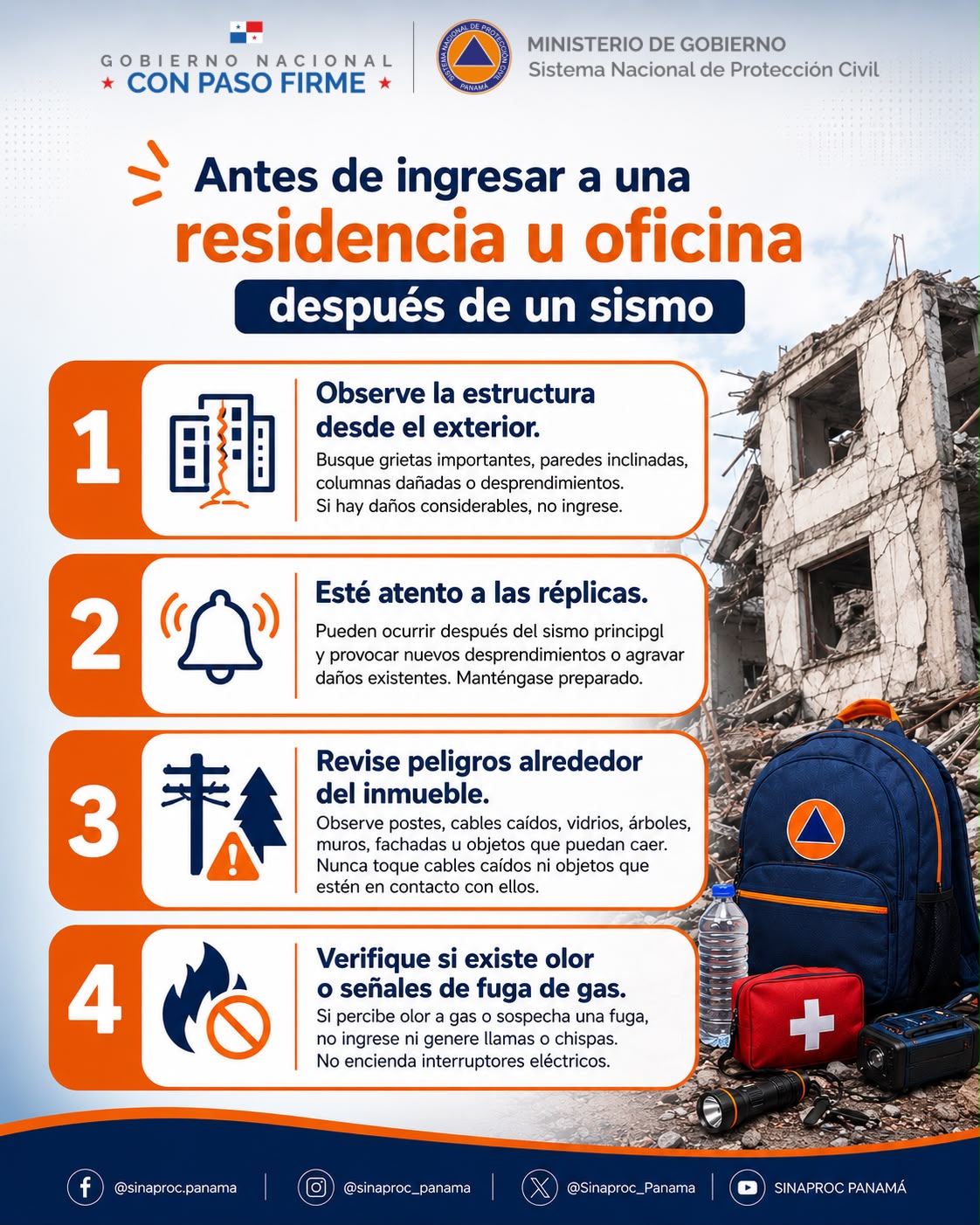
Safety first. After an earthquake, SINAPROC asks people to look at the structure from outside before entering: major cracks, leaning walls, damaged columns or falling pieces. If there is considerable damage, do not go in. Source: SINAPROC, August 2026 infographic
Location matters more than width. In the typical Panamanian house, block walls are confined by reinforced concrete tie columns and tie beams; a crack in those elements is not the same as a hairline crack in plaster. Source: REP-2021, sections 7.2.2 and 7.3.3
There is no "safe" width for every house. Technical criteria combine width with the element affected, the direction, whether the crack goes through the wall and whether steel or concrete is damaged. Source: FEMA 306, p. 97; CENAPRED, p. 80
If the cause is unknown, treat the crack as active. A crack that is still moving and gets sealed with a rigid material usually reopens alongside. Source: USACE, EM 1110-2-2002, pp. 2-4 and 4-7
Who decides. Engineering documents are signed and sealed with the professional's license registration number. Source: Ley 15 de 1959, art. 4
Reading map
Explore the key questions
Open a number on the drawing or a card to choose where to read next.
Illustrative diagram, without scale or diagnosis.
1Element
How your house is built (and why the crack's location matters)
Panama's structural code describes typical construction for one-story single-family homes.
Read the section and its sources →2Record
How to document the crack without putting yourself at risk
A good log saves visits, helps the engineer and shows whether the crack changes.
Read the section and its sources →3Assessment
What a professional evaluation involves
Knowing what to expect helps you compare proposals and not settle for an "it's nothing" said from the doorway.
Read the section and its sources →Before you look at the crack: is it safe to be inside?
First rule out immediate danger before approaching a crack. Check in this order, starting from outside.
If you need to decide whether to go back inside after shaking, follow the full earthquake return guide before examining the crack.
- Look at the structure from outside. Look for major cracks, leaning walls, damaged columns or falling pieces. If there is considerable damage, do not go in. Source: SINAPROC, step 1
- Expect aftershocks. They can bring down more material or worsen existing damage. Source: SINAPROC, step 2
- Look around. Poles, fallen cables, glass, trees, walls and façades that could fall. Never touch fallen cables or anything touching them. Source: SINAPROC, step 3
- Smell before entering. If you smell gas or suspect a leak, do not enter, do not create flames or sparks and do not flip switches. Source: SINAPROC, step 4
⛔ Call and stay out if you see this
Leaning or bulging walls, columns with spalled concrete or bent steel, parts of the roof or ceiling hanging, cracks in the ground around the house or sinking. Ground cracks and differential settlement point to a geotechnical problem, not just a wall problem. Source: SINAPROC; CENAPRED, p. 65
Emergencies: 911 or SINAPROC 520-4426 / 520-4427 / 520-4429, WhatsApp 6998-4809 (from any phone, 24 hours a day). Source: SINAPROC, official website
For evident or imminent risks, the law says SINAPROC, as far as it is able, warns the relevant public and private institutions and, if it deems it appropriate, takes protective measures on works, projects or buildings that could pose a risk to people. Source: Ley 7 de 2005, art. 12, as amended by Ley 233 de 2021, art. 27 In other countries, inspectors post green, yellow or red placards after a rapid review of about 30 minutes per building, and the rule is not to enter obviously unsafe buildings. Source: FEMA P-2055, pp. 2-3 and 2-4 We did not find a Panamanian regulation that sets up that placard system for homes, so do not assume it exists.
If a wall crack appears with an area of floor that seems to sink, the guide to a sinking floor and cracked walls helps record both signs and request an assessment without assigning a cause from a photo.
How your house is built (and why the crack's location matters)
Panama's structural code describes typical construction for one-story single-family homes. Placing the crack within that scheme is the first step to understanding it.
According to REP-2021, that typical construction has hollow concrete or clay block walls, reinforced concrete wall foundations, reinforced concrete tie beams and tie columns (vigas y columnas de amarre), a concrete slab on ground, a roof on purlins, a suspended ceiling and corrugated metal roofing. Source: REP-2021, 7.2.2, p. 52 Walls must be confined by those vertical (tie columns) and horizontal (tie beams) boundary elements. Source: REP-2021, 7.3.3, p. 58
Swipe the diagram sideways to see all of it.
| Layer or element | What it is | What a crack there means |
|---|---|---|
| Finish: paint, plaster, tile, ceiling | Covers the wall or hangs from the roof | It may be finish-only, but a photo cannot show how deep it goes. The ceiling is a nonstructural element that is also checked after an earthquake. |
| Block wall | Confined or reinforced masonry wall | If it crosses the blocks, goes through the wall or is diagonal, it is no longer cosmetic and needs an evaluation. |
| Tie columns and tie beams, slabs, foundation | Reinforced concrete structural elements | Evaluation by a licensed engineer before repair, even if it looks thin. |
⚠ Not every house is the typical house
Chapter 7 of REP-2021 only covers one-story single-family homes on the ground. Source: REP-2021, 7.1, p. 51 In apartment buildings, two-story houses or homes built without plans, the role of each wall is determined by the plans and a professional. If you live in a condominium, see also our guide on which walls are structural in an apartment.
Matrix: symptom, importance, action and professional
Use it to decide the next step, not as a diagnosis. If you are torn between two rows, take the more cautious one.
Urgent or high priority
- Leaning walls or damaged columns
- Roof or ceiling hanging down
- Cracks in the ground
- Crack in a column, beam, slab or foundation
- Spalled concrete or visible steel
- Diagonal or X crack across the blocks
- Crack visible on both faces
Medium priority
- Wall separated from the column
- Crack that grows or comes back
Low priority, to confirm
- Fine crack only in paint or render, with no other signs and no change
Summary of the matrix below. If you are unsure between two colors, take the more cautious one; the color guides priority, it does not classify the damage. Sources: SINAPROC, steps 1-4; CENAPRED, pp. 65 and 72; FEMA 306, pp. 23-24 and 31; USACE, pp. 2-4 and 4-7.
| What you see | Possible importance | Prudent action | Who to call |
|---|---|---|---|
| Leaning walls, damaged columns, roof or ceiling hanging, cracks in the ground | Urgent | Do not go in. Move people away and call. | 911 or SINAPROC; then a licensed civil engineer |
| Crack in a tie column or tie beam, slab or foundation | High | Do not patch. Restrict use of that area until evaluated. See what to do with a crack in a column or beam. | Licensed civil engineer, preferably with structural experience |
| Spalled concrete or exposed or rusted steel | High | Do not cover it with mortar. Log it and get an evaluation. What to do and how it is repaired: exposed rebar and spalling concrete. | Licensed civil engineer |
| Diagonal or X crack across the blocks | Medium to high | Log it, measure at several points and get an evaluation. | Licensed civil engineer |
| Crack that goes through the wall (visible on both faces) | Medium to high | Log both faces and get an evaluation. | Licensed civil engineer |
| Wall pulled away from the column (open joint) | Medium | Log the length and width of the gap; do not fill it yet. See crack between a wall and a column. | Licensed civil engineer |
| Cracked glass, recent scrapes or crushed drywall panels | Medium | Note it next to nearby cracks; it is evidence of movement. | Licensed civil engineer |
| Crack that grows or comes back after patching | Medium | Treat it as active: log dates and measurements. | Licensed civil engineer |
| Crack with water stains, efflorescence or rust | Depends | Find the water source before sealing. | Engineer if steel is rusting; plumber or waterproofer if it is a leak |
| Hairline crack only in paint or plaster, no other signs and no change | Low, to be confirmed | Record it from a safe place. A short series without change does not establish stability. | An engineer if it changes or the cause or member is uncertain; finishes only after the cause is clarified |
Cracks inclined at about 45 degrees across an element indicate that it took significant shear forces; in columns, horizontal cracks are usually associated with bending. Source: CENAPRED, p. 72 Recent scrapes, cracked windows and crushed wallboard are evidence of interstory movement during the earthquake. Source: FEMA 306, p. 31 For moisture stains, our guide on efflorescence on walls explains how to find where the water comes from.
If a crack appears beside a door that changed, see the door that will not close and cracks guide. It separates a rubbing leaf, an out-of-square frame and a necessary exit that no longer works.
Why width is not enough
Just compare what the top search results say: each site gives a different number, and none of them is a Panamanian standard.
- Where it isIt is not the same in render as in a column or beam.
- Its patternInclined at about 45° points to shear; horizontal in a column, to bending.
- Whether it changesIf it grows or comes back, it is treated as active.
- What comes with itCracked glass, fresh scrapes or leaning walls.
Depending on the crack type, and it recommends its own product. Source: Cemix
Over 1 mm inclined in a tie column is already "severe damage"; in the wall, over 5 mm. Source: CENAPRED, p. 80
The third figure is the instructive one: the same millimeter means different things depending on the element. That Mexican manual is written for trained evaluators, within a complete procedure, and for construction similar to Panama's: block walls confined by columns and beams, called castillos and dalas in Mexico. It is not a Panamanian standard or a rule for homeowners.
FEMA 306, one of the reference manuals for evaluating earthquake-damaged concrete and masonry walls, classifies damage by combining several criteria at once: crack width, spalling, buckled or fractured reinforcement and residual displacement. Its guides are not meant for inexperienced observers. Source: FEMA 306, pp. 23-24 and 97
⚠ If you measure anyway, measure properly
Measure at several representative points, avoid spalled edges and check whether the crack shows on the other face of the wall. A photo with the crack traced in marker does not let anyone infer its size. Source: FEMA 306, p. 31 True depth is rarely known without drilling or testing. Source: USACE, p. 2-11
Was it the earthquake, or was it already there?
Many cracks are first noticed after an earthquake because that is when people inspect the house. That does not mean the earthquake caused them.
Small loose flakes at the edges; light, uniform color inside; sharp, unworn edges. Source: FEMA 306, p. 23
Paint or dirt inside; water or rust stains seeping from the crack; earlier patches still intact; rounded edges. Source: FEMA 306, p. 23
FEMA 306 adds that damage must be consistent with how the whole structure behaved during the earthquake; if it is not, the crack may have another cause. Source: FEMA 306, p. 23 In Panama, two causes the code itself mentions are expansive soils, which shrink and swell with moisture and can damage the structure, and settlement, which foundations must limit. Source: REP-2021, 7.3.1 and 7.3.1.5, pp. 55-57 Water and steel corrosion are another: a corrosion crack is not fixed by filling it, but by removing and replacing the damaged concrete. Source: USACE, p. 4-7
Knowing whether the crack predates the earthquake matters for the diagnosis, for an insurance claim or for a dispute with the condominium. That is why it pays to log it as soon as possible.
How to document the crack without putting yourself at risk
A good log saves visits, helps the engineer and shows whether the crack changes. Only do it from areas where it is safe to stand.
- Locate it. Room, wall (north, patio side, the one with the door) and height. Draw a simple sketch.
- Identify the element. Plaster, block, column, beam, slab, ceiling? If you do not know, write "don't know": it is a valid answer.
- Photograph with a scale. A wide shot of the wall and a close-up with a ruler or tape next to the crack. Always repeat from the same spot.
- Measure without guessing. Length with a tape. If you measure width, do it at the same points every time and write it down; do not estimate it from the photo. Source: FEMA 306, p. 31
- Mark the ends. A thin pencil line with the date at each end shows whether the crack is getting longer. Professionals also use comparators and crack monitors, which must be read when installed because they do not always read zero. Source: USACE, p. 2-11
- Check the other face of the wall and note whether the crack goes all the way through. Source: FEMA 306, p. 31
- Note related signs: doors rubbing, uneven floors, new moisture, noises when walking, falling pieces.
- Repeat on fixed dates and after every felt earthquake or heavy rain.
Crack log sheet · free
Two printable PDF pages: tracking table, sketch area, list of warning signs and emergency numbers. Direct download, no data requested.
For a comparable series of readings, see how to track a changing crack.
Prefer Spanish? Hoja de registro en español.
This section records one crack. If other rooms, belongings or systems are affected, the whole-home file guide shows how to assemble the larger record for a professional, PH administration or insurer.
Who evaluates in Panama
Each one answers a different question. Mixing them up is where many problems start.
| Who | What for | Basis |
|---|---|---|
| 911 · SINAPROC | Immediate danger, considerable damage, evident risk to people or neighbors. | Ley 7 de 2005, art. 12, as amended by Ley 233 de 2021; official lines 520-4426/4427/4429 and WhatsApp 6998-4809. |
| Licensed civil engineer (ingeniero civil idóneo) | Diagnose the cause, say whether the structure is safe and define the repair. | Their documents carry a signature and a seal with their license registration number (Ley 15 de 1959, art. 4). |
| Condominium (PH) administration | If the crack is in the structure, the façade or another unit. | Foundations, columns, beams, slabs and exterior façade walls are essential common elements (Ley 284 de 2022, art. 16, item 6). If another unit caused the damage, the administrator must engage a licensed expert to determine its amount and origin (art. 29). |
| Municipality | Permit for the repair, not for the diagnosis. | In the district of Panama, building or repairing a wall requires a permit from the Works and Construction Department. |
| Repair contractor | Carry out what the diagnosis defines. | Works must be directed by a licensed person or firm (Ley 15 de 1959, art. 23). |
When hiring, ask for the professional's full name and license registration number, which the law requires on their seal. Source: Ley 15 de 1959, art. 4 The municipal procedure described applies to the district of Panama: the current DOYC minor works guide excludes remodeling involving structural changes or changes to electrical, plumbing, mechanical or wet fire protection systems from the Visto Bueno. Those cases use Plano Misceláneo. Confirm your specific scope with DOYC. Source: Mayor's Office of Panama, FAQ In San Miguelito, Arraiján, La Chorrera, Capira or any other district, the procedure is set by that municipality; this guide did not verify it, so ask its municipal engineering office before repairing.
In Panama, the registry of disaster losses and damage is coordinated by SINAPROC on the DesInventar platform, and a UTP study proposes a new format for its Damage Assessment and Needs Analysis (EDAN) form. Source: Montenegro, Hernández and Saavedra, UTP, 2021 That assessment serves the emergency response; it does not replace the diagnosis of your home that you need in order to repair it.
To locate your district authority and its publications, see the official routes for Panama, San Miguelito, Arraijan, La Chorrera and Capira. Provide the proposed scope so the authority can identify the applicable procedure.
What a professional evaluation involves
Knowing what to expect helps you compare proposals and not settle for an "it's nothing" said from the doorway.
- Safety review. As a reference for the United States procedure, FEMA describes a rapid review of about 30 minutes per building and a detailed evaluation of one to four hours. These are not Panamanian deadlines or a guarantee that a private visit will resolve your case. Agree its purpose, scope and deliverable. Source: FEMA P-2055, pp. 2-3 and 2-4
- Field study. REP-2021 requires the evaluation to be based on the actual structure: dimensions, steel, loads and material strength taken from what was built. Plans, if any, are only a preliminary reference. Source: REP-2021, 15.3.1, p. 105
- Measurements and, if needed, tests. Field checks include measurements, extraction and testing of material cores when required, and a survey of the damage. Source: REP-2021, 15.3.1
- Damage classification by element. The professional identifies how each component behaved and how severe the damage is, not just how wide the crack is. Source: FEMA 306, pp. 23-24
- Signed and sealed report with the diagnosis, likely cause, any use restrictions and the scope of the repair. Source: Ley 15 de 1959, art. 4
If your house plans exist, have them ready: they speed up the work. If you live in a condominium, Ley 284 requires the developer to hand a copy of the approved plans to the Board of Directors, so the administration is the first place to ask. Source: Ley 284 de 2022, art. 54
ℹ How much does it cost?
We did not find an official or verifiable public rate for a structural evaluation of a home in Panama. Ask for a written proposal and compare scope, whether it includes a signed and sealed report, whether it includes testing and how long it takes to deliver.
After the diagnosis: what repair options exist
The repair follows from the diagnosis, not the other way round. These are the families of work a professional may recommend; they are not recipes.
| Type of work | When it applies | Examples |
|---|---|---|
| Finish repair | The damage does not affect the structure and the crack has stopped moving. | Patching, re-plastering and painting; ceiling repair; partition walls. |
| Structural repair | An element must be restored to its original properties. | Rebuilding a section of column or beam to the same dimensions; epoxy injection into cracked concrete. |
| Strengthening | More strength is needed than the original structure had. | Jacketing columns with steel plates or reinforced concrete; coating walls with a layer of mortar or reinforced concrete. |
| Restructuring | The original structural system is changed, wholly or partly. | Adding concrete walls that did not exist before or building steel or concrete frames. |
Three rules the diagnosis should respect:
- Active and dormant cracks need different methods. Many active cracks "welded" with epoxy reopen next to the original crack. Source: USACE, p. 4-7
- Corrosion is treated by removing concrete, not covering it. Source: USACE, p. 4-7
- Structural strengthening is designed and inspected. REP-2021 requires strengthening systems to be backed by evidence, the calculation report to include that documentation and documented inspection by qualified staff during the works; if corrosion or other deterioration appears, it is reported to the design engineer. Source: REP-2021, 15.4, pp. 109-110
If the crack is in the finish or the diagnosis ruled out structural damage, the guide how to repair a wall crack without hiding the problem explains which method fits each case.
If the assessment finds extensive damage in a block wall, the guide repair or rebuild a block wall compares keeping it, replacing a section and rebuilding before requesting prices.
To estimate costs for work the diagnosis has already defined, see how much a block wall costs per m² or how much waterproofing costs if the problem was a leak. If there is a lot of damage at once, read whether to remodel or rebuild.
Common mistakes
- Painting or patching before understanding the cause. It hides the evidence the engineer needs and, if the crack is still active, it reopens. Source: USACE, p. 4-7
- Blaming every crack on the earthquake. Some cracks are old, from the soil, from settlement or from water; the damage has to be consistent with how the structure behaved. Source: FEMA 306, p. 23; REP-2021, 7.3.1.5
- Going into areas with falling pieces to take photos or get belongings. Aftershocks can worsen the damage. Source: SINAPROC
- Asking a mason to "certify" the house. A mason can repair finishes, but the technical document is signed and sealed by a licensed professional. Source: Ley 15 de 1959, arts. 4 and 23
- Deciding from a photo in a group chat. A photo does not show the other face of the wall, the depth or whether the crack changes. Source: FEMA 306, p. 31
- Using a millimeter rule from the internet as if it were a Panamanian standard. It is not (see section 05).
Three examples to help you decide
Illustrative cases, not real client cases. They show how to apply the matrix.
1. Hairline crack above the door, no change. After a tremor, a thin line appears in the plaster above the door frame. The family marks it in pencil on day 1, measures it at 30 cm long and repeats on days 7 and 30: still 30 cm, the mark has not moved and no other signs have appeared.
Decision: the log describes that period and those points; it does not establish that the cause has ended. These dates belong to the example and are not a waiting period. Ask before patching if the material or cause is uncertain. A finish repair follows clarification that the damage is superficial and a suitable method has been defined. If it grows or another sign appears, request assessment without waiting for another reading. Sources: USACE, pp. 2-4 and 4-7; Limits of an observation series
2. Diagonal crack visible on both faces. In the wall between the living room and a bedroom, an inclined crack appears across several blocks and is also visible from the other side.
Decision: "diagonal" and "goes through the wall" rows. Log both faces and ask a licensed engineer for an evaluation before patching.
3. Tie column with spalled concrete. At the corner of the carport a piece of concrete has fallen from the column and a rebar is visible.
Decision: "column" and "exposed steel" rows. Restrict use of that area, do not cover it with mortar and get an evaluation. If there are also leaning walls or roof damage, get out and call 911 or SINAPROC. More detail in the guide on cracks in columns and beams.
Frequently asked questions
When should I worry about a crack in a wall?
How can I tell if a crack is structural or just cosmetic?
Is there a crack width that is safe?
How can I tell if a crack is new or old?
What does a diagonal or X-shaped crack mean?
What does a horizontal or vertical crack mean?
Can a crack come from settlement or moisture rather than the earthquake?
How do I repair a cracked wall?
Can a mason tell me whether my house is safe?
Who do I call in Panama if my house cracked after an earthquake?
How much does a structural evaluation cost in Panama?
Do I need a municipal permit to repair the wall?
Sources
Consulted on October 9 and 10, 2026. Scanned documents were read with OCR and checked against the original image. Panamanian titles are kept in Spanish.
Notice. This guide is general educational information. It is not a technical report, it does not declare any home safe and it does not replace an inspection by a licensed professional or the instructions of SINAPROC or another competent authority. United States and Mexican sources are used to explain technical criteria; they are not Panamanian standards. The municipal procedure described applies to the district of Panama. Content verified in October 2026. Prepared by Gallardía (gallardia.lat).
Organizing the repair
Once a professional has defined what needs repairing, Gallardía can visit the home and quote the remodeling, painting and finishing work in Panama. The structural evaluation is the job of a licensed engineer.
Keep reading on Gallardía
This guide is part of gallardia.lat's content on home damage, repair and remodeling.