Exposed rebar and spalling concrete: what to do and how it is repaired properly
A chunk of concrete on the bathroom floor, a ceiling slab with rusted bars showing, or a balcony edge that keeps flaking off cannot be fixed with a coat of mortar on top. This guide explains why concrete spalls, what to do today so nobody gets hurt, what a proper repair involves and what the quote should say before anyone starts chipping.
- SafetyIs it safe to go in?
- DiagnosisWhat does the crack mean?
- Repair · You are hereExposed rebar
- DecisionRepair or rebuild?
Short answer
Do not cover it with mortar or paint. Keep people out from under the area, find where the water is coming from and have a licensed engineer look at the element. The engineer determines whether the work needs to restore the protective concrete cover and durability, or repair damage to the core, anchorage or bars to restore capacity.
ℹ The essentials in 60 seconds
Rust pushes the concrete off. Rust can expand to up to eight times the original steel volume: it cracks the concrete, spalls it and, at the same time, the bar loses section. Source: USACE, p. 3-6
Covering it does not stop it. Cracking caused by corrosion is best treated by removing and replacing the concrete, not by crack repair methods. Source: USACE, p. 4-7
The scope depends on the damage. For earthquake damage in concrete, FEMA P-2335 distinguishes replacing cover to restore appearance or durability from repairing damage to the core, anchorage or steel that impairs performance. The professional establishes which applies; even detached cover can leave pieces at risk of falling. Sources: FEMA P-2335, §5.5.1 and §5.9.4.1; SINAPROC, step 3
The bar is judged once exposed. If it has lost significant section it may need replacing, and if there is any doubt a structural engineer decides. Source: USACE, p. 5-19
First: is there danger today?
⛔ Step back and call if you see
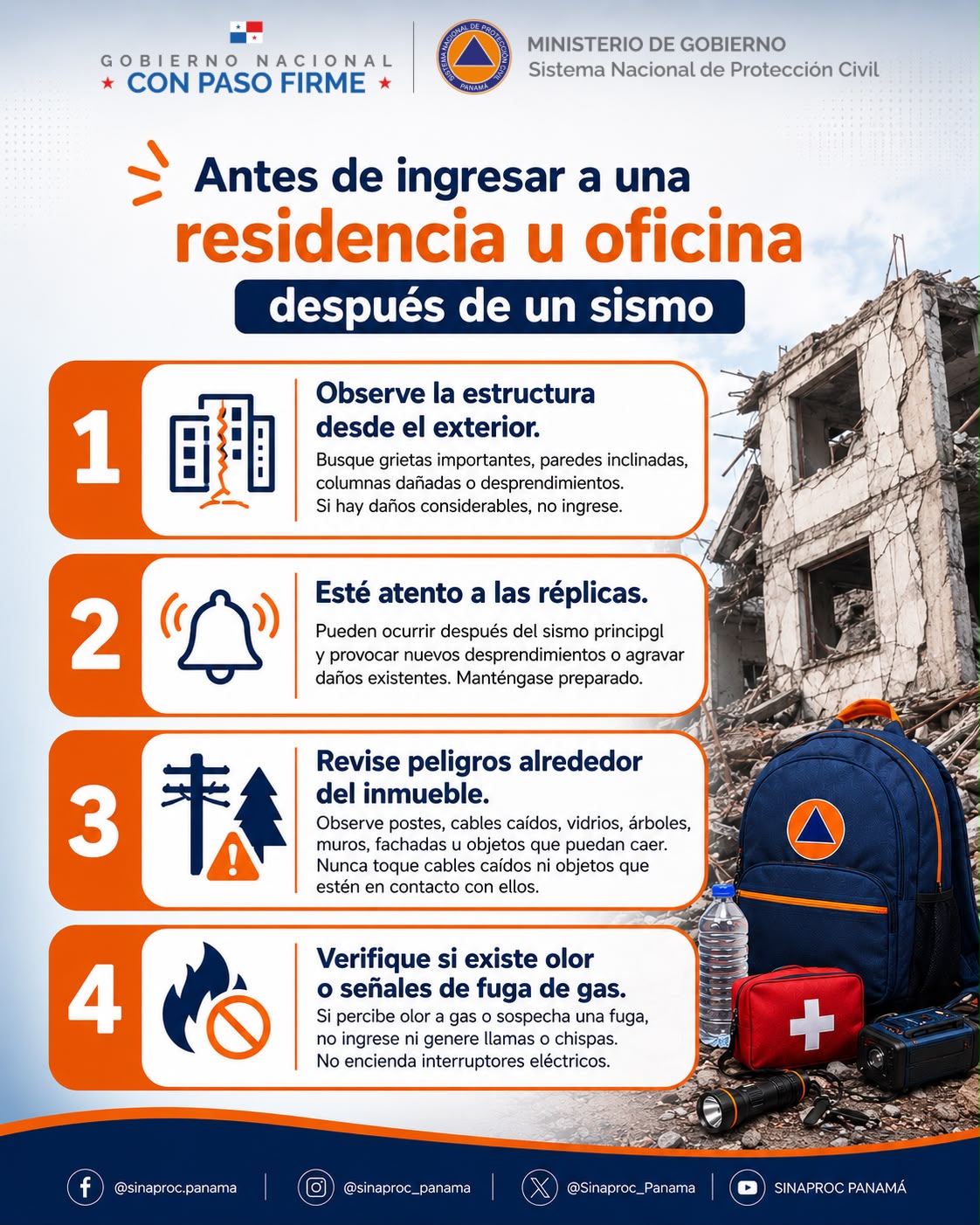
Damaged columns, leaning walls, falling pieces or considerable damage. SINAPROC asks people to look at the structure from outside and not to go in if there is considerable damage. Source: SINAPROC, August 2026 infographic, step 1
Emergencies: 911 or SINAPROC 520-4426 / 520-4427 / 520-4429, WhatsApp 6998-4809 (from any phone, 24 hours a day). Source: SINAPROC, official site
A piece of concrete falling from a ceiling or a balcony can injure someone even if the slab is not about to fail. SINAPROC lists walls, facades and objects that could fall among the things to check after an earthquake. Source: SINAPROC, step 3 So the first step is to close off the area underneath and not stand right below it to look.
This is not an exaggeration: in December 2024, access was closed to several sections of the Ministry of Health (Minsa) regional building in Panamá Oeste where the roof slab had spalled, and SINAPROC, the Fire Department and the UTP agreed that the structure should be demolished. Source: Panamá América, December 31, 2024 That report does not say what caused the damage; it shows that a slab spall is treated first as a safety problem.
Reading map
Explore the key questions
Open a number on the drawing or a card to choose where to read next.
Illustrative diagram, without scale or diagnosis.
1Risk area
First: is there danger today?
A piece of concrete falling from a ceiling or a balcony can injure someone even if the slab is not about to fail.
Read the section and its sources →2Assessed repair
How it is repaired properly
Whoever evaluates defines the procedure.
Read the section and its sources →3Quotation
What the quote must say
If a quote only says «patch exposed rebar», ask for detail.
Read the section and its sources →Why concrete spalls
A frequent cause is steel rusting inside the concrete. In others, the concrete was crushed by a load, such as an earthquake.
- Water, chlorides or carbonationthe concrete loses its protection of the steel
- The steel rustsrust can expand to up to eight times the original volume
- Rust stainsfirst visible sign
- Parallel cracksstraight, spaced like the bars
- Spallingthe bar is exposed and loses section
Concrete protects steel thanks to its high alkalinity, but that protection can be lost over time through carbonation, and chlorides make corrosion easier. Source: USACE, p. 3-6 Steel placed too close to the surface, or exposed to chlorides, corrodes. Source: USACE, p. 2-10 The typical sequence is rust stains first, then straight parallel cracks spaced like the bars and, finally, the concrete spalls and the bars become visible. Source: USACE, p. 3-6
A structural evaluation manual explains that many spalls with exposed bars come from bond problems and the expansion of rusting steel, and that others come from crushing of the concrete, sometimes with buckling of the bars. Source: CENAPRED, p. 73 The difference matters: the second case, typical of a column after an earthquake, is not a maintenance problem.
A UTP study of reinforced concrete slabs exposed in Penonomé and Tocumen concluded that the marine-industrial environment was the most critical. Source: Sánchez and Hernández, 2021 Another UTP study notes that buildings deteriorate particularly in tropical climates and that in Sherman, Colón, airborne chloride is extremely high because of waves on the breakwater. Source: Cedeño de Sánchez et al., 2022
A UTP thesis that studied three buildings in Panama City concluded that the most common damage was corrosion and cracking due to lack of proper maintenance. Source: Valdés, 2009 (abstract) It is a study of three buildings, not a national statistic, but it matches what the technical guides describe.
Among the measures to protect steel, the USACE technical manual lists low-permeability concrete, proper curing, adequate cover and good drainage so water does not stand on the concrete. Source: USACE, p. 3-6 That is why a bathroom ceiling, a roof with puddles or a balcony without slope deserve special attention.
REP-2021 requires homes to be designed for durability, for a service life of at least 50 years, considering how aggressive the environment is, the concrete cover over the steel and the chloride content. Source: REP-2021, 7.4.1.3, p. 69 Structural concrete is designed to ACI 318-19. Source: REP-2021, 8.1, p. 86
Where it appears and what to look at
Use this to describe what you see and set priorities, not as a diagnosis.
Urgent or high priority
- Column with crushed concrete or bent bars
- Loose or hanging pieces over a walkway
- Extensive spalling on a slab or beam, or in a multi-story building
- Rusted bars visible over a small area, not deformed
Medium priority
- Straight parallel cracks with rust stains
Low priority, to confirm
- Isolated rust stains, no cracks
Summary of the table below. The cause and scope are confirmed by whoever evaluates. Sources: SINAPROC; CENAPRED; USACE; REP-2021.
| What you see | Priority | What to do | Source |
|---|---|---|---|
| Column with crushed concrete or bent bars, especially after an earthquake | Urgent | Step back, do not go in if there is considerable damage, and call. This is not corrosion to be patched. | SINAPROC; CENAPRED, p. 73 |
| Loose or hanging pieces of concrete over a walkway (ceiling, balcony, eave) | High | Close off the area below and have a professional remove what is loose and evaluate. | SINAPROC, step 3 |
| Extensive spalling on a slab or beam, or in a multi-story building | High | Evaluation by a licensed engineer before any repair. | REP-2021, 15.3.1 |
| Rusted bars visible over a small area, not deformed | High | Avoid the affected area and request assessment of the element and steel before repairing; find the water source. | USACE, pp. 3-6 and 5-19 |
| Straight parallel cracks with rust stains, no spalling yet | Medium | Record from a safe position and request an assessment. A professional may locate delamination by sounding; occupants should not strike concrete overhead. | USACE, pp. 2-10 and 3-6 |
| Isolated rust stains, no cracks | Low | Record them with a photo and date and check where the moisture comes from. | USACE, p. 3-6 |
Free sheet to record it
Write down the date, place, measurements and photos of each area before anyone touches it; it helps the engineer, the condo administration and you, to see whether it progresses. Direct download, no data requested.
If the damage is on a cracked column or beam, the guide crack in a column or beam explains how to read each pattern. If water comes through the roof, see roof leaks after an earthquake, and if the spall is on the outside of the building, facade cracks and falling pieces.
What not to do
- Cover it with mortar or paint. The rust keeps growing underneath and spalls the concrete again; corrosion is treated by removal and replacement. Source: USACE, pp. 3-6 and 4-7
- Chip blindly. A hammer can damage the bar further if the person chipping does not know where the steel is; the technical manual calls for using the drawings and a detector to locate it. Source: USACE, p. 5-19
- Paint the rust and plaster over it without removing the damaged concrete. The guides reviewed call for removing all damaged material and cleaning off loose rust; none presents an anti-corrosion product as a substitute for those steps. Sources: USACE, pp. 5-17 and 5-19; FEMA 308, p. 32
- Stand underneath to look, or tap it from below. Loose pieces can fall. Source: SINAPROC, step 3
- Repair without stopping the water. If water keeps reaching it, new or cleaned steel is exposed to the same thing again. Source: USACE, p. 3-6
How it is repaired properly
Whoever evaluates defines the procedure. These are the stages the technical guides describe, so you know what to ask.
FEMA 308 is historical guidance from 1999. For assessment and repair of earthquake-damaged concrete, FEMA P-2335 from May 2025 updates the 306-308 series for concrete wall buildings and extends coverage to frames; it still refers to that series for masonry. The older details here help you understand questions about the work. A professional defines the actual method and materials, considering the damage and its cause. Source: FEMA P-2335, §§1.5 and 1.7
- Edge cut with a saw or grinder, perpendicular to the surface (FEMA 308, p. 32).
- All damaged concrete removed down to sound concrete (USACE, p. 5-17).
- If more than half of the perimeter is exposed: clear space behind the bar of 6 mm plus the maximum aggregate size (USACE, p. 5-19).
- Bar inspected and cleaned of all loose rust, or replaced if it lost section; an engineer decides this (USACE, p. 5-19).
- Repair material in layers, cured as the manufacturer specifies; bond is what matters most (FEMA 308, pp. 32-33).
- Survey the damage close to the date of the work. The amount of concrete to remove is best estimated with a survey made shortly before the repair; if a lot of time passes, the damage keeps advancing. Source: USACE, p. 5-17
- Mark out and cut the edge. The perimeter of the spall is cut with a saw or grinder to leave an edge perpendicular to the surface. Source: FEMA 308, p. 32
- Remove all damaged concrete down to sound concrete: the USACE manual suggests continuing until aggregate particles break rather than pull out of the paste. Source: USACE, p. 5-17
- Free the bar. If more than half of its perimeter is exposed, removal continues until there is a clear space behind it of 6 mm plus the maximum aggregate size, so the repair material can surround it completely. Sources: USACE, p. 5-19; FEMA 308, p. 32
- Assess and clean the steel (section 07). Source: USACE, pp. 5-19 and 5-20
- Prepare the surface. The repair is only as good as the surface preparation, however expensive the material. Thin patches, under 50 mm, get a bonding coat; if it is an epoxy or polymer product, it is applied as the manufacturer says, because applied badly it reduces bond. Source: USACE, pp. 5-17 and 5-18
- Place the repair material in layers and cure it following the manufacturer's instructions. What matters most is the bond of the patch to the existing concrete. Source: FEMA 308, pp. 32-33
- Large spalls may need formwork and concrete, or shotcrete, instead of a hand-applied mortar. Source: FEMA 308, p. 33
Worth knowing in advance: almost all repair mortars shrink as they cure, and a fine crack may appear around the patch. FEMA 308 suggests a non-shrink mix or planning a cosmetic finish days or weeks later. Source: FEMA 308, p. 33
If the spall is on a structural element and the repair is part of a rehabilitation, REP-2021 requires rigorous, documented inspection by qualified staff, and any significant corrosion found during the work must be reported to the design engineer. Source: REP-2021, 15.4, pp. 109-110
The rebar: clean, add or replace
What is decided while the bar is exposed determines whether the repair lasts.
- Is the concrete crushed, or are the bars bent or buckled?Yes: this is not a patchAn engineer's evaluation before touching anything.
- After removal, is more than half of the bar's perimeter exposed?Yes: free it from behind and continueClear space of 6 mm plus the maximum aggregate size; then question 3.
- Has corrosion significantly reduced its section, or is there doubt?Yes: the engineer decidesIt may need replacing with a lap splice (ACI 318).
- Is the existing bar being kept?Yes: clean it thoroughlyAll loose rust, including the underside; repeat if it rusts again.
- Inspect it. If corrosion has significantly reduced its section, it may have to be replaced; if there is any doubt about its capacity, a structural engineer decides. Source: USACE, p. 5-19
- Plan the decision in the contract. The USACE manual recommends that the contract allow the repair-or-replace decision to be made during the work, as the steel is exposed. Source: USACE, p. 5-19
- Replace with a splice. The easiest way is to cut out the damaged length and splice in new bars, preferably with a lap splice, with lengths per ACI 318. Mechanical splices are approved by a structural engineer. Source: USACE, p. 5-19
- Clean thoroughly the bar that stays: all loose rust and dirt, with a wire brush for small areas or dry sandblasting for large ones, including the underside of the bar. Source: USACE, p. 5-19
- Clean again if needed. If loose rust forms again before the material is placed, the bar is cleaned again just before. Source: USACE, p. 5-20
An honest note: with ordinary reinforcing steel, damage to the concrete shows long before the bar loses enough section to affect its capacity; with prestressing steel, a small loss can cause a serious failure. Source: USACE, p. 3-6 That is one more reason to act at the first spall, not a guarantee that your slab is fine: only whoever evaluates it can say that.
What the quote must say
If a quote only says «patch exposed rebar», ask for detail.
- The cause and how it will be stopped: where the water comes from or what caused it.
- The area marked on a sketch, including zones that sound hollow when tapped. Source: USACE, p. 2-10
- How far concrete will be removed and whether the bar will be freed from behind. Source: USACE, p. 5-19
- What happens if the bar has lost section: who decides and how replacement is priced. Source: USACE, p. 5-19
- How the steel and the surface will be cleaned.
- The repair material, with its data sheet, and how it will be cured. Source: FEMA 308, p. 32
- Adjustable quantities: the real damage is known once chipping starts, so a unit price for additional area is useful. Source: USACE, p. 5-17
- Who signs if the element is structural, and the permit. Source: Ley 15 de 1959, arts. 4 and 23
This guide does not publish prices: the cost depends on the area, access and what turns up when the concrete is removed. To compare offers, see also how to choose a remodeling company.
Who evaluates, and the permit
- A licensed civil engineer, with signature and seal, when the spall is on a slab, beam or column. In Panama, works are directed by licensed professionals. Source: Ley 15 de 1959, arts. 4 and 23 The evaluation is based on the actual structure and a survey of the damage. Source: REP-2021, 15.3.1, p. 105
- Strengthening or modifying a structural element is a structural alteration under REP-2021; only non-structural remodeling does not require an evaluation. Source: REP-2021, 15.1, pp. 102-103
- Permit in the district of Panama. The Visto Bueno permit for minor works excludes remodeling with structural changes, which is processed as a Plano Misceláneo with a licensed professional registered with the JTIA. Source: DOYC, Visto Bueno guide, 2026, pp. 1-2 Confirm the permit before starting: its classification depends on the actual repair scope. Source: Alcaldía de Panamá, FAQ
In other districts each municipality sets the procedure; this guide did not verify it. Ask before you start.
To locate your district authority and its publications, see the official routes for Panama, San Miguelito, Arraijan, La Chorrera and Capira. Provide the proposed scope so the authority can identify the applicable procedure.
If you live in a condo (PH)
- The slab is common property. Foundations, columns, beams, slabs, the roof and other structural parts are essential common property. Source: Ley 284 de 2022, art. 16, num. 6
- Shared floor slabs. Owners with shared elements pay equally for repairing shared floor slabs and walls; if one of them caused the damage, they pay it within 30 days. Source: Ley 284, art. 24
- Water from another unit. If the water rusting your ceiling comes from the apartment above, liability for damage between units applies. Source: Ley 284, arts. 29 and 56, num. 15
- Urgency. The administrator orders urgent repairs in common areas. Notify them in writing, with photos and the date. Source: Ley 284, art. 93, num. 12 and 13
- Licensed staff. Each owner must use only qualified staff for repairs. Source: Ley 284, art. 56, num. 9
Common mistakes
- Patching only what fell. Around it there is usually concrete that already sounds hollow and will come loose later. Source: USACE, p. 2-10
- Leaving the bar «stuck» to the old concrete. If it is not freed from behind when needed, the material does not surround it. Source: USACE, p. 5-19
- Applying the bonding product by eye. Applied badly, it reduces bond. Source: USACE, p. 5-18
- Pricing a fixed amount without planning for what will appear. Source: USACE, pp. 5-17 and 5-19
- Mistaking an earthquake spall for a rust spall. Crushed concrete with buckled bars is something else. Source: CENAPRED, p. 73
Three examples to decide
Illustrative cases, not real client cases.
1. The bathroom ceiling. Two pieces fell from the slab above the shower and three rusted bars are visible. Around them, the concrete sounds hollow over an area about two hands wide.
Decision: rows «rusted bars over a small area» and «cracks with rust». Stop the moisture, repair everything that sounds hollow and not just what fell, and assess the bars' section once they are exposed.
2. The balcony of a beachfront condo. The edge of the balcony is flaking and pieces fall onto the sidewalk.
Decision: row «loose pieces over a walkway». Close off the area, notify the administration in writing (it is common structure) and ask for an engineer's evaluation. The marine environment is the most aggressive according to the UTP.
3. After the earthquake, a column with burst concrete and bars bulging outward.
Decision: row «crushed concrete or bent bars». This is not a patch: step back, call and wait for the evaluation. For column diagnosis, go to crack in a column or beam.
Frequently asked questions
How is exposed rebar repaired?
How do I cover or protect exposed rebar?
Does an anti-corrosion coating or rust converter work on rebar?
Can a concrete slab ceiling with exposed rebar fall?
Is rusted rebar still usable?
What repair mortar is used?
What is the minimum concrete cover over rebar?
What is concrete carbonation?
Why did the patch crack around the edge?
Do I need a permit to repair a slab or column?
I live in a condo (PH): who pays to repair the slab?
Sources
Consulted on October 10, 2026. Scanned documents read with OCR and checked against the original image.
Notice. This guide is general educational information. It is not a technical report, it does not declare any home or slab safe and it does not replace an inspection by a licensed professional or SINAPROC's instructions. The United States and Mexican sources explain technical criteria; they are not Panamanian standards. The procedures described apply to the district of Panama. Content verified in October 2026. Prepared by Gallardía (gallardia.lat).
Organizing the repair
Once a licensed engineer has defined the repair, Gallardía can visit the home and quote the remodeling, waterproofing, painting and finishing work that follows. Diagnosis and structural design are the job of a licensed engineer.
Keep reading on Gallardía
This guide is part of the series on home damage: safety first, then diagnosis and then repair.