Facade cracks and falling pieces: what to do
The facade takes sun, rain and wind, and whatever comes loose from it lands on the sidewalk, the parking space or the entrance. So a crack outside raises two questions: whether something can fall now, and whether the damage is only in the finish or in the wall underneath. This guide puts those two questions in order, explains how each layer is repaired and what Ley 284 and the municipal permit require in Panama.
- SafetyIs it safe to go in?
- Diagnosis · You are hereFacade
- RepairRepair without hiding the problem
- DecisionRepair or rebuild?
Short answer
If there are loose or hanging pieces or bulging areas up high, keep people out of the fall zone before anything else. Then identify which layer is damaged: paint, render, cladding, a projecting element or the wall itself. Only paint and render with no underlying damage are repaired as a finish; everything else needs an inspection.
ℹ The essentials in 60 seconds
What is adhered can fall. FEMA lists render (stucco), tile, ceramic and adhered stone among the adhered veneers that can be a significant falling hazard; the risk rises with thicker, heavier pieces. Source: FEMA E-74, p. 6-11
Water breaks the bond. Poorly adhered veneer comes loose more easily where water or deterioration of the backing has damaged the bond. Source: FEMA E-74, p. 6-12
The finish can reveal the wall. Cracked veneer can reveal incipient structural damage underneath. Source: FEMA E-74, p. 6-15
In a PH, the facade belongs to everyone. The exterior walls of the facades are essential common property. Source: Ley 284 de 2022, art. 16, item 6
First: what can fall
⛔ Clear the area and call if you see
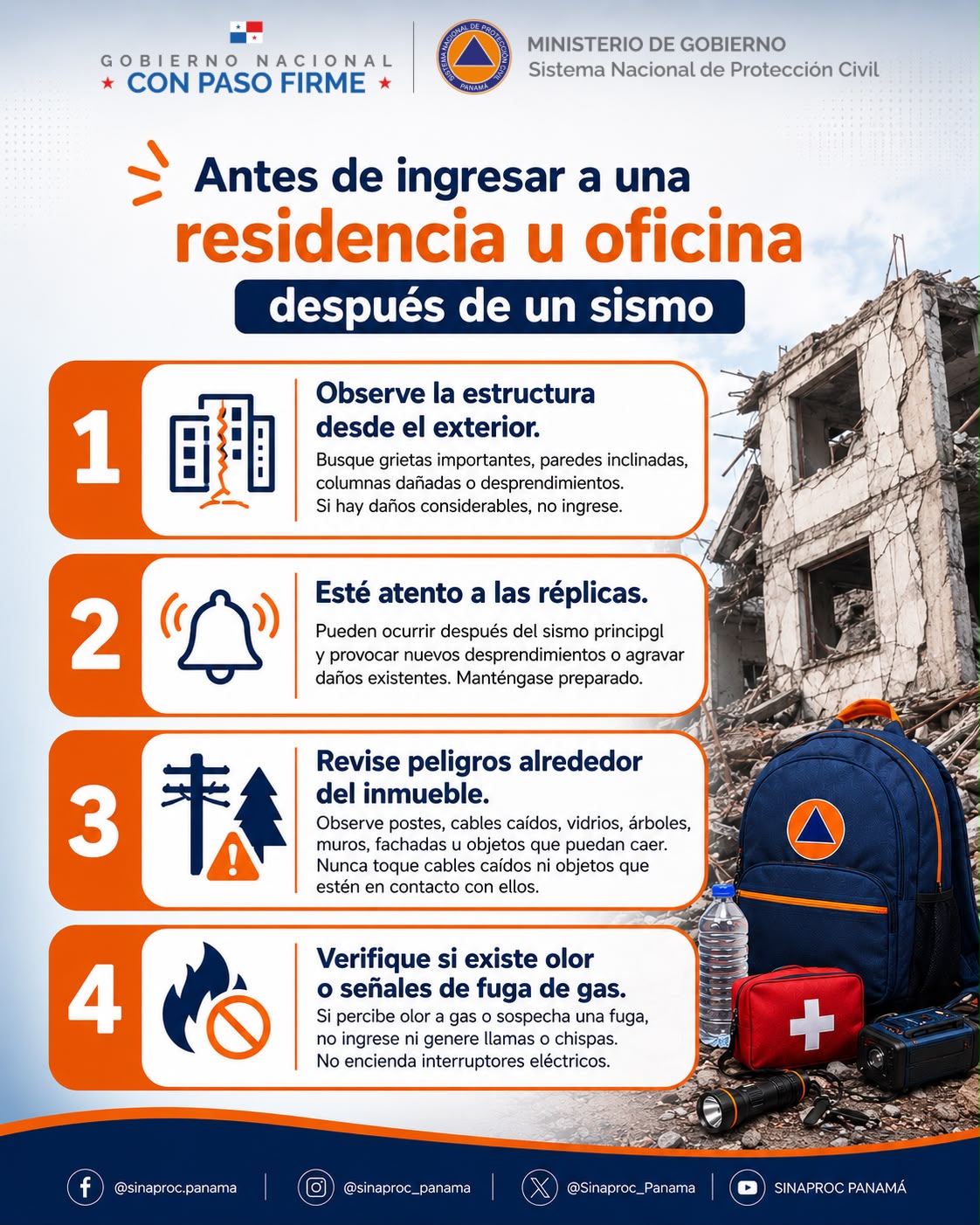
Pieces of render, cladding or concrete hanging or already fallen, a cracked cornice, parapet or eave, a loose sign or canopy, broken glass block, or leaning walls. SINAPROC asks you to look from outside at walls, facades and objects that could fall, and not to enter if there is considerable damage. Source: SINAPROC, August 2026 infographic, steps 1 and 3
Emergencies: 911 or SINAPROC 520-4426 / 520-4427 / 520-4429, WhatsApp 6998-4809 (from any phone, 24 hours a day). Source: SINAPROC, official website
FEMA recommends restricting access below veneer with a barrier or a wide landscaping strip, and removing veneer located above exits or pedestrian walkways. Source: FEMA E-74, p. 6-16 Until it is inspected, use another entrance if you can and do not park underneath. Even a small piece falling several stories can cause serious injury. Source: FEMA E-74, p. 6-130 A failed parapet rarely brings the building down, but it puts anyone walking next to the wall at risk. Source: FEMA 306, p. 141
If the damage appeared after an earthquake and you are not sure whether to go in, start with is it safe to enter my house after an earthquake?
- Loose or hanging pieces up high.
- Fall zone: keep it clear, no walking or parking underneath.
- Sidewalk, parking or entrance under the zone: use another route until it is inspected.
- Observe from outside the zone and at a distance.
Reading map
Explore the key questions
Open a number on the drawing or a card to choose where to read next.
Illustrative diagram, without scale or diagnosis.
1Falling material
First: what can fall
FEMA recommends restricting access below veneer with a barrier or a wide landscaping strip, and removing veneer located above exits or pedestrian walkways.
Read the section and its sources →2Affected layer
Which layer is damaged
Under Ley 284, "facade" means any external part or area of the units.
Read the section and its sources →3Horizontal property
If you live in a PH (condominium)
Read the section and its sources →Which layer is damaged
Under Ley 284, "facade" means any external part or area of the units. Source: Ley 284 de 2022, art. 6, item 23 Separating it into layers helps you describe the damage and know who inspects it.
- Block or concrete wall: it supports the finish; its structural role must be established in the assessment.
- Render: cracks from shrinkage or comes loose (hollow area, in red).
- Paint or coating: only bridges dormant cracks.
- Adhered cladding: comes off if water or deformation damages the bond.
- Projection (eave, cornice): a crack at its base is high priority.
- Water: enters through cracks and joints and degrades the bond.
| Layer | What can happen | What the sources say |
|---|---|---|
| Paint or coating | Peels, flakes or shows fine cracks | It must adhere to the surface; coatings only bridge dormant cracks (FEMA 308, pp. 24-25) |
| Render (repello) | Fine map cracking, areas that sound hollow, pieces that come off | New render on a rigid wall tends to crack from shrinkage; if the base does not bond, it is anchored mechanically (FEMA 308, p. 25). It is an adhered veneer that can fall (FEMA E-74, p. 6-11) |
| Adhered cladding (tile, ceramic, stone) | Cracked, loose or fallen pieces | They come loose from deformation of the backing or loss of bond, especially with water (FEMA E-74, p. 6-12) |
| Anchored cladding (stone or panels on clips) | Displaced or fallen pieces, rusted clips | Pieces at corners and around openings are the most vulnerable; corrosion of the anchors is a concern (FEMA E-74, p. 6-20) |
| Projections: cornices, parapets, eaves, canopies, signs | Cracks at the base, loose pieces, rusted hardware | They can fall; assessing them requires engineering judgment (FEMA E-74, pp. 6-130 and 6-136 to 6-137) |
| Glass block | Broken or loose blocks | If laid in rigid mortar with no room for movement, they can break and fall (FEMA E-74, pp. 6-48 and 6-49) |
| Wall, column, beam or slab | Through cracks, spalled concrete, exposed bars | It may affect a load-resisting element or its support: a licensed engineer evaluates it (REP-2021, 15.3.1). See crack in a column or beam |
The Panamanian Structural Code requires all facade systems to resist the wind and earthquake loads set by the code, and large architectural elements to be checked as nonstructural components. Source: REP-2021, 1.6.4 and 1.6.5, p. 5 In single-family homes, the render on the blocks is part of the masonry governed by chapter 7. Source: REP-2021, 7.4.3, p. 75 Being "nonstructural" does not mean a piece does not matter.
Why it cracks or comes loose
New render on a rigid wall tends to crack as it dries. Source: FEMA 308, p. 25 Drying shrinkage leaves fine cracks with no signs of movement. Source: USACE, p. 3-11
Water entering through cracks and joints degrades the bond of the veneer or the backing, and a poorly adhered piece can come loose. Source: FEMA E-74, p. 6-12 If there are also white stains or efflorescence, see the guide to efflorescence on walls.
Adhered veneers crack or come loose when the wall supporting them deforms. Source: FEMA E-74, p. 6-12 FEMA 306 adds that deformation incompatibility between an appendage and the structure causes cracking and spalling. Source: FEMA 306, p. 140
Steel too close to the surface or exposed to chlorides rusts, grows up to eight times in volume, cracks the concrete over the bar and eventually spalls it. Source: USACE, p. 2-10 On anchored cladding and cantilevered items, corroded anchors or hardware can fail early. Source: FEMA E-74, pp. 6-20 and 6-136
In unreinforced masonry, veneer separates when ties are missing or inadequate. Source: FEMA 306, p. 140
Adhered veneers are sensitive to deformation of the wall that supports them. In a case from Chile in 2010, the veneer cracked exactly where the concrete wall was damaged and stayed intact where the wall barely deformed. Source: FEMA E-74, p. 6-15
⚠ A note on the sources
FEMA E-74, FEMA 306 and FEMA 308 are United States guides. Several of their cases (parapets, cornices, ties) describe unreinforced masonry, which differs from the confined masonry of the typical Panamanian house. They are cited to explain damage and repair mechanisms, not as Panamanian standards or to predict how your house will behave.
What to look for on the facade
Use it to describe what you see and decide the next step, not as a diagnosis.
Urgent or high priority
- Hanging, loose or fallen pieces
- Projections cracked at the base
- Leaning wall or cracks that go through it
- Spalled concrete with exposed bars
- Cracked cladding over a wall or column (medium to high)
Medium priority
- Render that sounds hollow or bulges
- Crack that opens between dates
Low priority, to confirm
- Fine map cracking, no moisture or hollow areas
- Paint peeling with no cracks (find the cause)
Summary of the table below. A licensed professional confirms the cause. Sources: SINAPROC; FEMA E-74; FEMA 308; USACE; REP-2021.
| What you see | Possible importance | What to do | Source |
|---|---|---|---|
| Hanging, loose or fallen pieces; projections cracked at the base | Urgent | Clear the fall zone, use another entrance and have it inspected. | SINAPROC; FEMA E-74, pp. 6-16 and 6-130 |
| Leaning or bulging wall, or cracks that go through it | Urgent | Do not enter that area. Call and ask for an engineer's evaluation. | SINAPROC |
| Spalled concrete with exposed bars (eaves, balconies, columns) | High | Clear the area below and ask for a structural evaluation. See exposed rebar and spalling concrete. | USACE, p. 2-10; REP-2021, 15.1 |
| Cracked cladding over a wall or column | Medium to high | Check whether the wall underneath is also damaged; log it and ask for an inspection. | FEMA E-74, p. 6-15 |
| Area of render that sounds hollow or looks bulged | Medium | If it is up high or over a walkway, treat it as a possible detachment. | FEMA E-74, p. 6-12; USACE, p. 2-10 |
| Crack that opens or lengthens between dates | Medium | Treat it as active: log it and do not paint over it. | USACE, p. 2-4; FEMA 308, p. 25 |
| Fine map cracking in the render, with no moisture or hollow areas | Low, to confirm | Photograph, mark and monitor. It is usually shrinkage. | FEMA 308, p. 25; USACE, p. 3-11 |
| Paint peeling with no cracks underneath | Low | Find the cause of the poor adhesion (moisture, efflorescence) before repainting. | FEMA 308, p. 24 |
To classify vertical, horizontal or diagonal cracks in the wall, use the matrix in the guide wall cracks: when to ask for an evaluation. If the crack runs along the joint between the wall and the column or the roof, the right guide is crack between a wall and a column.
How to check and log it
- Look from the ground and from a distance, outside the fall zone. Use your phone's zoom for high areas instead of climbing a ladder.
- Photograph each whole facade and then each damaged spot up close, with a size reference, from the same point.
- Note the layer (paint, render, cladding, projection or wall) and what comes with it: moisture, stains, rust, pieces on the ground.
- Check the inside face of the same wall. FEMA asks you to check the other face to see whether the crack goes through. Source: FEMA 306, p. 31
- Repeat on fixed dates and after every earthquake or heavy rain.
Hollow areas are located by tapping the surface: in concrete, a hollow sound marks delamination and a sharp "ping" marks sound material. Source: USACE, p. 2-10 On a tall facade, that check is done by whoever will carry out the repair, with safe access and equipment.
Free logging sheet
The crack log also works for the facade: date, location, measurements and photos. Direct download, no data requested.
Who evaluates and what to ask
- Structural damage or projections: a licensed civil engineer. Their documents carry a signature and seal with their license number. Source: Ley 15 de 1959, art. 4 Parapets, cornices and appendages require engineering judgment even though their function is nonstructural. Source: FEMA E-74, p. 6-130
- An inspection of what was actually built, with field checks and a damage survey. Source: REP-2021, 15.3.1
- A statement of which layer is damaged and why, whether loose pieces must be removed right away and whether access must be restricted during the repair.
- If it is only the finish: ask for the repair to explain how the cause (water, an active crack) is addressed, not just the patch.
We found no official or public fee for this evaluation in Panama; ask for the proposal in writing.
How it is repaired (once there is a diagnosis)
| Diagnosis | Type of repair | Source |
|---|---|---|
| Dormant crack in the finish, no underlying damage | Clean surface free of loose material; a coating that reduces water entry. Some paints bridge small cracks according to the manufacturer. A test area is advisable | FEMA 308, pp. 24-25 |
| Moving crack that must stay watertight | Routing and sealing with a flexible sealant; a rigid coating will not bridge it | FEMA 308, p. 25; USACE, pp. 6-6, 6-18 and 6-19 |
| Loose or spalled render or concrete | Remove all loose material down to a sound base, prepare and replace; the critical point is the bond. A fine crack may appear around the patch from shrinkage | FEMA 308, pp. 32-33 |
| New render on a base that does not bond | Mechanical anchorage of the render to the wall | FEMA 308, p. 25 |
| Exposed, rusted bars | Expose the steel all around so the patch can wrap it; corrosion is treated by removal and replacement according to the diagnosis | FEMA 308, p. 32; USACE, p. 4-7 |
| Cracked or loose cladding | Repair the pieces and the damaged backing; above exits or walkways, consider removing it or giving it a positive connection to the structure | FEMA E-74, p. 6-16 |
| Projections, anchors or damage in the wall | Strengthening or reconnecting is a structural alteration designed by a licensed engineer | REP-2021, 15.1; FEMA E-74, pp. 6-133 and 6-138 |
If moisture comes from the roof-wall junction, the guide roof leaks after an earthquake separates water paths from damage needing another assessment.
Painting over an active crack does not close it: FEMA warns that if the cause is shrinkage, temperature or something other than the earthquake, coatings will not bridge the crack. Source: FEMA 308, p. 25 If the problem is water, the guide waterproofing over old waterproofing explains how the surface is prepared.
If you live in a PH (condominium)
- The facade is essential common property. So are the structural parts, the roofs and all the exterior walls of the facades. Source: Ley 284 de 2022, art. 16, item 6
- Everyone contributes. Each owner pays toward the upkeep, maintenance and repair of common property according to the share in the Reglamento de Copropiedad. Source: Ley 284, art. 25
- Urgent repairs. The administrator orders urgent repairs in common areas and asks owners to carry out those affecting other units or common property. Source: Ley 284, art. 93, items 12 and 13 Notify in writing, with photos.
- Modifying is not repairing. Modifying or adding to facades requires consent from 66 % of the property units, a study by a licensed architect and approval from the competent authorities. Source: Ley 284, art. 32(6), amended by Ley 467 de 2025
- Penalty. For an alteration without those requirements, the community judge or competent authority may require the modified elements to be restored. Consult the current text before starting an alteration. Source: Ley 284, art. 32(6), amended by Ley 467 de 2025
- Eaves and other objects. Adding them requires 66 % and the authorities, and they may not project beyond the horizontal footprint of the floors. Source: Ley 284, art. 32, item 4
Municipal permit
- Minor works. In the district of Panama, the Visto Bueno permit covers finishes and facades in homes. Source: DOYC, Visto Bueno guide, 2026, p. 1
- If it touches the structure, it is not covered by the Visto Bueno and is processed as a Plano Misceláneo. Source: DOYC, 2026, p. 1
- No permit means fines. Confirm the permit before starting work. Authorization depends on the defined scope and the competent municipal office. Source: Alcaldía de Panamá
In other districts, each municipality sets its own procedure; this guide did not verify them.
To locate your district authority and its publications, see the official routes for Panama, San Miguelito, Arraijan, La Chorrera and Capira. Provide the proposed scope so the authority can identify the applicable procedure.
Common mistakes
- Repairing without clearing the fall zone. Source: FEMA E-74, p. 6-16
- Painting over a crack that moves. Source: FEMA 308, p. 25
- Patching over hollow render without removing the loose material down to a sound base. Source: FEMA 308, p. 32
- Covering rusted bars with mortar without treating the corrosion. Source: USACE, pp. 2-10 and 4-7
- Treating cracked cladding as purely cosmetic without looking at the wall underneath. Source: FEMA E-74, p. 6-15
- In a PH, changing materials or adding elements on your own. Source: Ley 284, art. 32
Three examples to decide
Illustrative cases, not real client cases.
1. Fine map cracking in the render of a two-year-old house. No moisture, no hollow areas, unchanged after several weeks.
Decision: "fine map cracking" row. Log it; if it stays still, it is treated as a finish with a clean surface and a suitable coating.
2. A piece of render fell next to the door after a downpour. Around it, the surface sounds hollow and there are damp stains.
Decision: "fallen pieces" and "hollow area" rows. Clear the entrance, find where the water gets in and remove the loose material down to a sound base before replacing it.
3. Building in a PH: after an earthquake, tiles fall from the facade and the cladding on a column looks cracked.
Decision: "fallen pieces" and "cracked cladding over a column" rows. Restrict access, notify the administration in writing and ask for an evaluation of the column before the cladding is replaced.
Frequently asked questions
Is a piece falling off the facade dangerous?
Why is the facade of my house cracking?
What does it mean when the render sounds hollow?
How is detached render repaired?
Does elastomeric paint work on facade cracks?
What do I do if facade cladding or tiles fall off?
I live in a condominium (PH): who repairs the facade?
Can I change the finish on the facade of my apartment?
Do I need a permit to repair the facade?
Does insurance cover a facade detachment?
Sources
Consulted on October 10, 2026. Scanned documents read with OCR and checked against the original image.
Notice. This guide is general educational information. It is not a technical report, it does not declare any home or facade safe and it does not replace an inspection by a licensed professional or SINAPROC's instructions. The United States sources describe other building systems and are not Panamanian standards. The procedures described apply to the district of Panama. Content verified in October 2026. Prepared by Gallardía (gallardia.lat).
Organizing the repair
When the damage is only in the finish, or an engineer has already defined the repair, Gallardía can quote the patching, sealing and painting of the facade. The structural evaluation is the job of a licensed engineer.
Keep reading on Gallardía
This guide is part of the series on damage in homes: safety first, then diagnosis, then repair.