Is it safe to go back inside after an earthquake?
No one can certify that a home is safe from the street, over the phone, or from a photograph. Follow official instructions before approaching it. If you are on the coast and the shaking made it difficult to stand, move to a designated safe area. Otherwise, look at the building and its surroundings from outside. If you see substantial damage, fallen power lines, or signs of a gas leak, do not enter; ask for help. Sources: SINAPROC, “Sismos”; SINAPROC, steps 1, 3 and 4
- Safety · You are hereCheck before going in
- DiagnosisWhat does the crack mean?
- RepairRepair without hiding the problem
- DecisionRepair or rebuild?
The decision in one minute
People's safety comes first; possessions can wait. A homeowner's visual check can identify reasons to stay out. It cannot certify that a building is sound.
⛔ Stay out and move away from the hazard
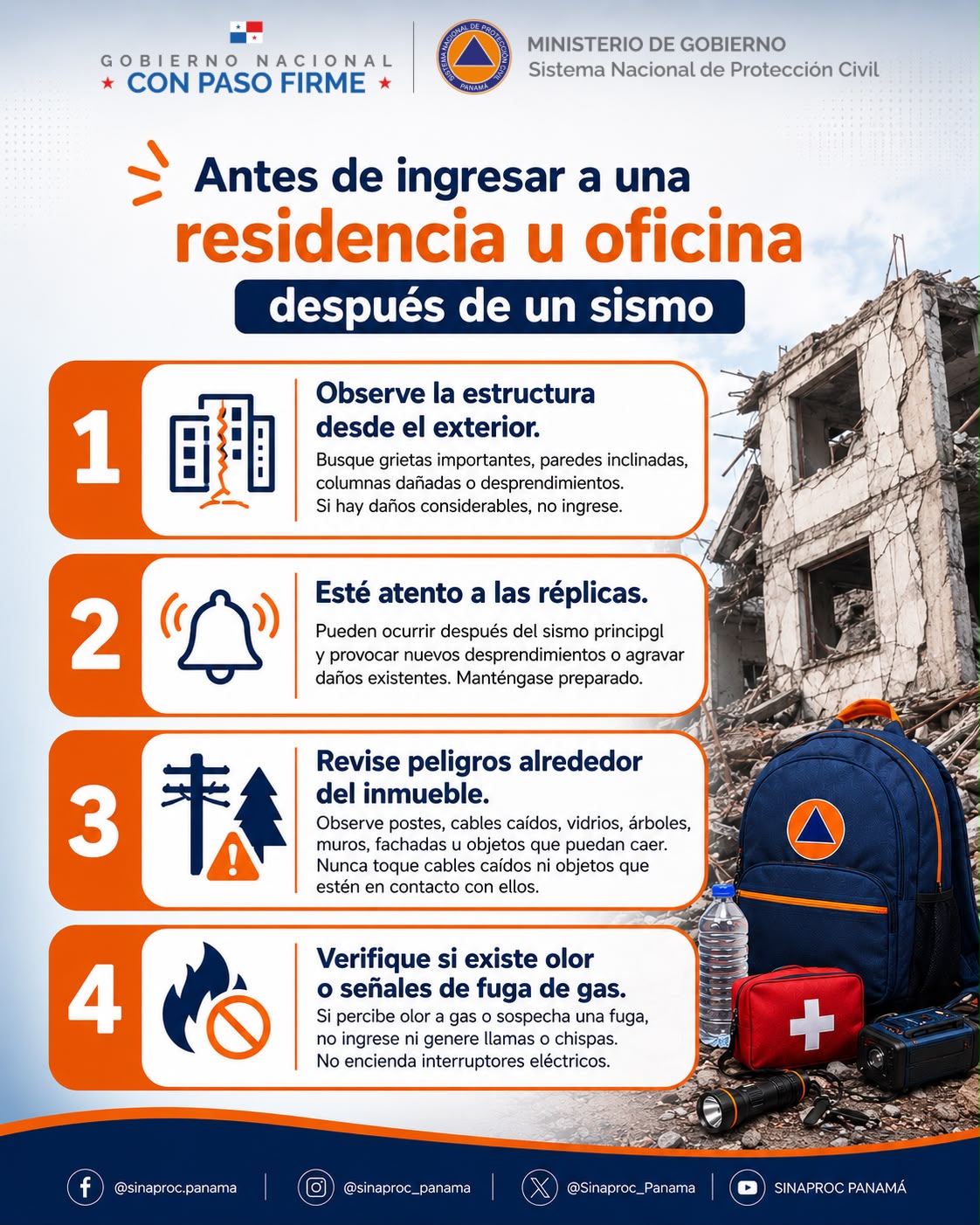
SINAPROC says not to enter if you see leaning walls, significant cracks, damaged columns, falling material, or other substantial damage. Do not touch fallen cables or anything in contact with them. If you smell gas or suspect a leak, avoid flames, sparks, and electrical switches. Source: SINAPROC, infographic, steps 1, 3 and 4
Report the danger: call 911 or SINAPROC at 520-4426 / 520-4427 / 520-4429. If you suspect a gas leak, Panama's Fire Department says to evacuate and call 103. Sources: SINAPROC, contact details; Fire Department, gas leaks
If your building was evacuated, an area is cordoned off, or an authority or building manager has issued instructions, follow them. Panama's Fire Department advises not returning home until it has been assessed, because structural damage may not be immediately visible. SINAPROC has documented precautionary evacuations followed by returns after initial inspections. Neither example is a general clearance for your particular home. Sources: Fire Department, “Después del sismo”; SINAPROC, August 2026 inspections
Even when you see no warning sign, you have not proved structural safety. Watch for aftershocks, official notices, and new damage. Base the decision to return on the relevant official instructions and, when needed, an assessment of the property. Aftershocks can bring down loose material or worsen existing damage. Sources: SINAPROC, step 2; Fire Department, “Después del sismo”
Start with where you are
The route to the home may pose more danger than the doorway. Assess your location before walking toward the building.
On the coast: if the earthquake made it difficult to stand, SINAPROC says to evacuate immediately toward designated safe areas. Do this before checking cracks, shutting off utilities, or collecting belongings. Follow your locality's official alerts and evacuation routes. Source: SINAPROC, “Sismos,” “Actúa”
At a meeting point: stay away from structures that might collapse and from electrical lines. Wait for official instructions. If someone is missing, tell responders where that person was last seen; do not enter a visibly damaged building to search on your own. The meeting point and instructions come from Panama's Fire Department. Source: Fire Department, “Después del sismo”
If you are still inside: during an aftershock, protect your head and neck. When the shaking stops, follow an available evacuation route and responders' instructions. The Fire Department says not to use elevators during an evacuation. Avoid walking beneath loose glass, facades, or cables just to reach your usual exit; ask emergency personnel for a safe route. Sources: SINAPROC, “Protégete”; Fire Department, “Durante el sismo”; SINAPROC, step 3
Use text messages to contact family and rely on official reports. The earthquake's magnitude or distance from its epicenter does not by itself determine whether one particular home can be occupied. You need information about the site and the building. Sources: SINAPROC, “Actúa”; SINAPROC, inspections
Reading map
Explore the key questions
Open a number on the drawing or a card to choose where to read next.
Illustrative diagram, without scale or diagnosis.
1Safe place
Start with where you are
The route to the home may pose more danger than the doorway.
Read the section and its sources →2Outside observations
Four outside checks, in order
SINAPROC's Panama specific infographic sets out four steps before entering.
Read the section and its sources →3Request assessment
Who to call and what to request
An emergency call, a safety inspection, and a repair quote serve different purposes.
Read the section and its sources →Four outside checks, in order
SINAPROC's Panama specific infographic sets out four steps before entering. Make these observations from a position clear of anything that could fall.
- Detached or hanging pieces on the facade or roof.
- Zone where pieces could fall: do not stand under it or walk next to a leaning wall.
- Fallen poles and cables: do not touch anything in contact with them.
- Observe from a distance and decide in advance where you would move if there is an aftershock.
- Structure. Look for significant cracks, leaning walls, damaged columns, and falling material. Observe the facade and roof without standing beneath them. If damage is substantial, stay out. You do not have to measure a crack to make that cautious decision. Source: SINAPROC, step 1
- Aftershocks. Be prepared for more shaking while you observe. Know where you would move. An aftershock can dislodge material or worsen damage already present. Source: SINAPROC, step 2
- Surroundings. Check poles, fallen wires, glass, trees, walls, facades, and loose objects. Touch neither a wire nor anything that touches one. Do not walk next to a leaning wall to test the door. Source: SINAPROC, step 3
- Gas. If you smell gas or suspect a leak, stay out. Do not create flames or sparks or use electrical switches. Move away and call emergency services. Sources: SINAPROC, step 4; Fire Department, gas leaks
An outside check does not require touching walls, forcing doors, or lifting debris. If you cannot see one side safely, record that it was not observed. A missing photograph is never a reason to take an unnecessary risk. The downloadable sheet separates “seen,” “not seen,” and “unknown,” so an assessor will not mistake a blank answer for an absence of damage.
Our guide to cracks in walls explains the symptoms after the immediate safety question has been addressed. At this stage, identify whether a significant crack or a damaged structural element means stopping and requesting an assessment. Avoid applying a millimeter rule borrowed from another building type or another country. Sources: SINAPROC, step 1; REP-2021, §§ 7.1 and 7.3.3
A return decision tree
Read from top to bottom. A danger response stops the sequence; other reassuring answers do not cancel it.
- Are you on the coast and did the earthquake keep you from standing?Yes: evacuateMove to a safe zone; the house is checked later.
- Is there an evacuation order, cordon or restriction?Yes: do not go backWait for the authority or the building administration.
- Do you see considerable damage, a falling hazard or cables?Yes: stay awayMove away and report the place and the sign.
- Is there a gas smell or suspected leak?Yes: evacuateNo switches or flames; call the Fire Department at 103.
- No signs visible from outside?Still: do not conclude it is safeFollow official notices and ask for an evaluation if in doubt.
| Question | If yes | What next |
|---|---|---|
| Are you on the coast, and did shaking make it hard to stand? | Evacuate to a safe area. | Follow official alerts; check the home later. SINAPROC |
| Is there an evacuation order, cordon, or restriction? | Do not return. | Wait for the authority or building manager. Fire Department; SINAPROC |
| Do you see substantial damage, falling hazards, or cables? | Keep away and stay out. | Report the location, warning sign, and people present. SINAPROC |
| Do you smell gas or suspect a leak? | Evacuate, without switches or flames. | Call the Fire Department on 103 from a safe place. SINAPROC; Fire Department |
| Do you see no warning signs outside? | Do not certify the home as safe. | Follow official instructions and ask for an assessment if there is damage, uncertainty, or an evacuation. Fire Department; SINAPROC |
This tree puts public guidance in a usable order; it does not replace an inspection. A wall may conceal a problem. SINAPROC reported a building with no visible effects during an initial review for which it still recommended a structural assessment. The Fire Department also warns of damage that is not immediately visible. Sources: SINAPROC, 2026 inspections; Fire Department, “Después del sismo”
What to notice without acting as an inspector
The useful question is “what changed, and where?”, not “how many millimeters can this house tolerate?”
Walls, columns and beams: note whether a wall leans, there is a significant crack, or a column is damaged or shedding concrete. For one story homes with confined masonry walls, REP-2021 describes tie columns and tie beams as boundary elements. That chapter has a specific scope; it does not describe every building in Panama. If you do not know your home's structural system, do not infer it from the paint. If you already see a crack in a column or beam, follow the guide what to do before repairing it. Sources: SINAPROC, step 1; REP-2021, §§ 7.1 and 7.3.3, pp. 51 and 58
If a leak appears after the earthquake, address safety first, then use the guide roof leaks after an earthquake to separate roof type, slab, electrical risk and the water source.
Things that could fall: from a distance, look at the roof, awnings, suspended ceiling, glass, eaves, facades, and neighboring walls. One loose object along the access route can make entry unsafe even if the interior looks unchanged. SINAPROC lists falling material, glass, walls, and facades among hazards to check before entry. Source: SINAPROC, steps 1 and 3
Ground and access: if ground, a staircase, or a passage has shifted, separated, or filled with debris, describe it without walking over the area to test it. SINAPROC's report includes precautionary evacuations associated with floor slab damage and damaged stair areas. These cases show why looking only at the living room wall is insufficient. Source: SINAPROC, August 2026 inspections
New versus old damage: do not automatically attribute every mark you find after an earthquake to the shaking. SINAPROC noted preexisting conditions that had to be distinguished from earthquake effects. Look for earlier photos, maintenance records, or the last date someone saw the surface intact. If you do not know when it appeared, write “date unknown.” Source: SINAPROC, inspection report
A photo helps communication, but it cannot show the full depth, length, or concealed parts of a crack. Avoid patching, painting, or removing material before a possible assessment has documented the issue. That preserves information for the person examining the property; it does not mean every mark is structural. For crack patterns, read our separate crack guide.
If access is authorized, keep an exit available
An authorization or initial inspection applies to a particular time and scope. If a new warning sign appears, stop and seek fresh guidance.
Enter only in accordance with the authority's, building manager's, or assessor's instructions. Stay out of restricted areas. Use a flashlight and keep the exit route clear. SINAPROC recommends flashlights instead of candles, matches, or lighters because of possible gas leaks. If you smell gas or suspect a leak, leave without operating switches and call 103. Sources: SINAPROC, “Actúa”; Fire Department, gas leaks
SINAPROC advises households to know where their water and gas shutoff valves and main electrical switch are. It also recommends shutting off gas and electricity after an earthquake and confirming that no gas leak exists before restoring them. Do not reenter a dangerous area just to reach a valve. Tell responders where it is instead. If an installation is damaged or you do not know how to operate it, ask for qualified help. Source: SINAPROC, “Prepárate” and “Actúa”
If you find a new significant crack, damaged column, falling material, leaning wall, or suspicious smell inside, leave and report the change. A door that opens, working lights, or a neighbor who stays inside does not establish safety. Do not cover a possible symptom with a cosmetic repair before its cause is understood. Sources: SINAPROC, steps 1 and 4; Fire Department, “Después del sismo”
If the exit works but a door stopped closing and cracks appeared, the door and cracks guide helps record both changes and ask what assessment is needed. A blocked exit retains the safety priority explained here.
What if nothing looks damaged?
“I did not see anything” describes a limited observation. It is not an engineering opinion.
Some surfaces are concealed, and some rooms or wall faces cannot be checked without access or equipment. The Fire Department warns of structural damage that may not be immediately visible. In one case reported by SINAPROC, a building with no visible effects on initial inspection still had a recommendation for structural assessment. That does not mean every home has hidden damage; it means no visible sign is not a certificate of safety. Sources: Fire Department, “Después del sismo”; SINAPROC, inspections
If shaking led to evacuation of your building, if common areas were reportedly damaged, or if you are uncertain about what you saw, ask the manager or authority about the inspection's status. For an individual house, request professional assessment when there are new warning signs or substantial uncertainty. The report should state which areas were examined, what could not be examined, and what measures are recommended. REP-2021 treats plans as a preliminary reference and calls for necessary field checks and a damage survey where damage exists. Source: REP-2021, § 15.3.1, p. 105
Reassess if there are aftershocks or a new change. Do not treat a fixed waiting period or a magnitude number as permission to enter: the Panamanian sources reviewed give no universal rule of that kind for every home. Sources: SINAPROC, step 2; Fire Department, “Después del sismo”
If you live in a PH condominium or multistory building
Your apartment's condition also depends on shared stairs, facades, slabs, and services.
During evacuation, the Fire Department says to use the stairs, not the elevator. Once outside, ask the building administration which areas have been assessed, which remain restricted, and what instructions the authority issued. Do not use the condition of your unit as an assessment of the whole building. SINAPROC's August 2026 report included damaged stair areas and apartments that remained under evaluation. Sources: Fire Department, “Durante el sismo”; SINAPROC, inspections
Ley 284 de 2022, article 16(6) lists foundations, columns, beams, slabs, roofs, and exterior facade walls among essential common property. If you see damage to one of these, tell the administration where it is and keep a record of its instructions. Avoid commissioning an isolated repair to shared structure before responsibility and diagnosis are clarified. Our guide to apartment walls explains the shared element context.
If part of the building is cordoned off, do not cross the barrier to collect documents or pets. Tell the responsible team what you need and where it is. This guide deals with the access decision; the damage assessment and any insurance claim come after people are protected.
Who to call and what to request
An emergency call, a safety inspection, and a repair quote serve different purposes.
| Situation | Contact | Useful information |
|---|---|---|
| Immediate danger or trapped people | 911 or SINAPROC 520-4426 / 4427 / 4429 | Address, safe access, people affected, and visible hazard. SINAPROC |
| Gas smell or suspected leak | Fire Department 103 from a safe place | Location, smell, and whether people left. Do not operate switches. Fire Department |
| Structural damage or uncertainty without immediate danger | A licensed civil engineer; also the administration in a PH | Ask for a written scope, site visit, areas checked, and report with conclusions and limitations. REP-2021, §15.3.1; Ley 284, art. 16 |
SINAPROC also lists WhatsApp 6998-4809 as available around the clock. Record the incident number, time, and instructions you receive. If a line does not answer during an immediate danger, use another official emergency line. Source: SINAPROC, “Sismos” footer
For a structural assessment, ask the professional to identify the property, purpose of the visit, elements observed, access limitations, damage recorded, and recommended action. In Panama, Ley 15 de 1959, article 4 requires a licensed engineer's documents to carry a signature and stamp with name, professional title, and registration number. REP-2021, §15.3.1 calls for field checks and a damage survey where appropriate. A plaster repair quote is not a substitute for that report. For the scope and deliverables, see what to ask for in a home structural inspection.
Record what you can without taking risks
A useful record separates facts, uncertainty, and instructions received. It helps you communicate with responders, building managers, or an engineer.
Note the earthquake's date and time from official information, the address, and the exact location of the issue: north facade, stairwell, column beside the kitchen, or bedroom wall. For each item, note “I saw it,” “someone reported it,” or “I could not see it.” If you can take a photograph from a safe position, include an overall view and one that shows its context. Never enter or stand under loose material to improve a photograph.
Record whether the element already had a mark. Earlier photos, maintenance messages, or a dated account from someone who saw it intact may help. SINAPROC distinguished preexisting damage from conditions possibly related to an earthquake during its inspections. Do not write “the earthquake caused it” if all you know is that you discovered it afterward. Source: SINAPROC, August 2026 inspections
Also note smells, cables, falling hazards, access restrictions, aftershocks, and the agency you called. Copy the instruction you received along with its time and report number. If something changes, add a new entry instead of overwriting the old one. The sheet is not a diagnostic tool; it tells the next person what was and was not observed.
After earthquake observation sheet
Free printable PDF, with no form. Space for outside hazards, access status, contacts, and items still to be checked.
If the home is insured, use this record to report a possible loss without assigning an unverified cause. The home insurance and earthquake guide explains which policy documents to request and how to separate notice of loss from a dispute.
When observations span several rooms, the whole-home damage record guide organizes photographs, dates, inventory and deliveries without replacing the access assessment.
Four illustrative situations
These examples apply the order of decisions. They are not Gallardía projects and do not certify the response for any real property.
Example 1. Coastal home. Shaking was strong enough that family members struggled to stand. A parent wants to collect documents. They first move to the designated safe area and follow official alerts. Checking the house comes later. Source: SINAPROC, “Actúa”
Example 2. Damaged column beside the entrance. From across the street, someone sees falling material and a leaning wall. Although the door opens and there is no gas smell, they do not cross the threshold. They report the hazard to 911 or SINAPROC from a position away from falling objects and wait for assessment. Sources: SINAPROC, steps 1 and 3; SINAPROC, contact details
Example 3. Apartment without interior cracks. The living room looks unchanged, but a corridor is cordoned off and a stairwell is cracked. The family does not use the elevator or cross the barrier; they consult the administration and wait for return instructions. One room's appearance does not settle the safety of common access. Sources: Fire Department; SINAPROC, inspections; Ley 284, art. 16
Example 4. No visible damage, but gas smell. The family does not enter to close a valve or touch the doorbell. They move away and call 103. An intact facade does not eliminate a utility hazard. Sources: SINAPROC, step 4; Fire Department, gas leaks
Frequently asked questions
How do I know whether it is safe to go back inside after an earthquake?
What should I check first after my home shakes?
Can I go back in if I see no cracks?
What if I smell gas after the earthquake?
Can I return for documents or pets?
Who checks a home for structural damage in Panama?
What if I live in a PH condominium?
Who should I call in Panama if my home appears damaged?
Sources
Consulted October 9 and 10, 2026. Scanned legal originals were read using OCR and checked against their images; the SINAPROC infographic was checked visually.
Notice. This guide is general information and does not declare any home safe. It does not replace instructions from SINAPROC, the Fire Department, or another competent authority, or an in person assessment by a licensed professional. Examples are illustrative. Reviewed October 2026.
Plan the repair
Once a professional has determined the work needed and access is permitted, Gallardía can quote remodeling, painting, and finishing work. Structural assessment belongs to a licensed engineer.
Keep reading at Gallardía
After the immediate safety question is resolved, these pages cover symptoms and subsequent work.