Crack in a column or beam: what to do before repairing it
A column or a beam holds up the house. That is why a crack in one is treated differently from a hairline crack in the plaster: first rule out danger, then identify the cause with a licensed engineer, and only then decide on the repair, the permit and, if you live in a condominium, who pays.
- SafetyIs it safe to go in?
- Diagnosis · You are hereCrack in a column or beam
- RepairRepair without hiding the problem
- DecisionRepair or rebuild?
Short answer
Do not cover it, log it and ask a licensed engineer to evaluate it. If there are damaged columns with spalled concrete, bent steel or leaning walls, stay out and call.
ℹ The essentials in 60 seconds
It is structure. In the typical house, tie columns and tie beams confine the block walls; in a condominium, columns, beams and slabs are essential common elements. Source: REP-2021, 7.3.3; Ley 284 de 2022, art. 16
Touching it is a structural alteration. The code uses that term for modifying or strengthening beams and columns, and only non-structural remodeling is exempt from evaluation. Source: REP-2021, 15.1
Direction guides, it does not diagnose. Inclined at about 45 degrees points to shear; horizontal in a column or vertical in a beam, to bending; straight and parallel to the bars with rust, to corrosion. Source: CENAPRED, p. 72; USACE, p. 3-6
The repair has a procedure. In the district of Panama, the Visto Bueno for minor works excludes structural changes, which go through a Plano Misceláneo. Source: DOYC, Visto Bueno guide, 2026
First: is there immediate danger?
A damaged column can be a reason not to go in. This comes before any measurement.
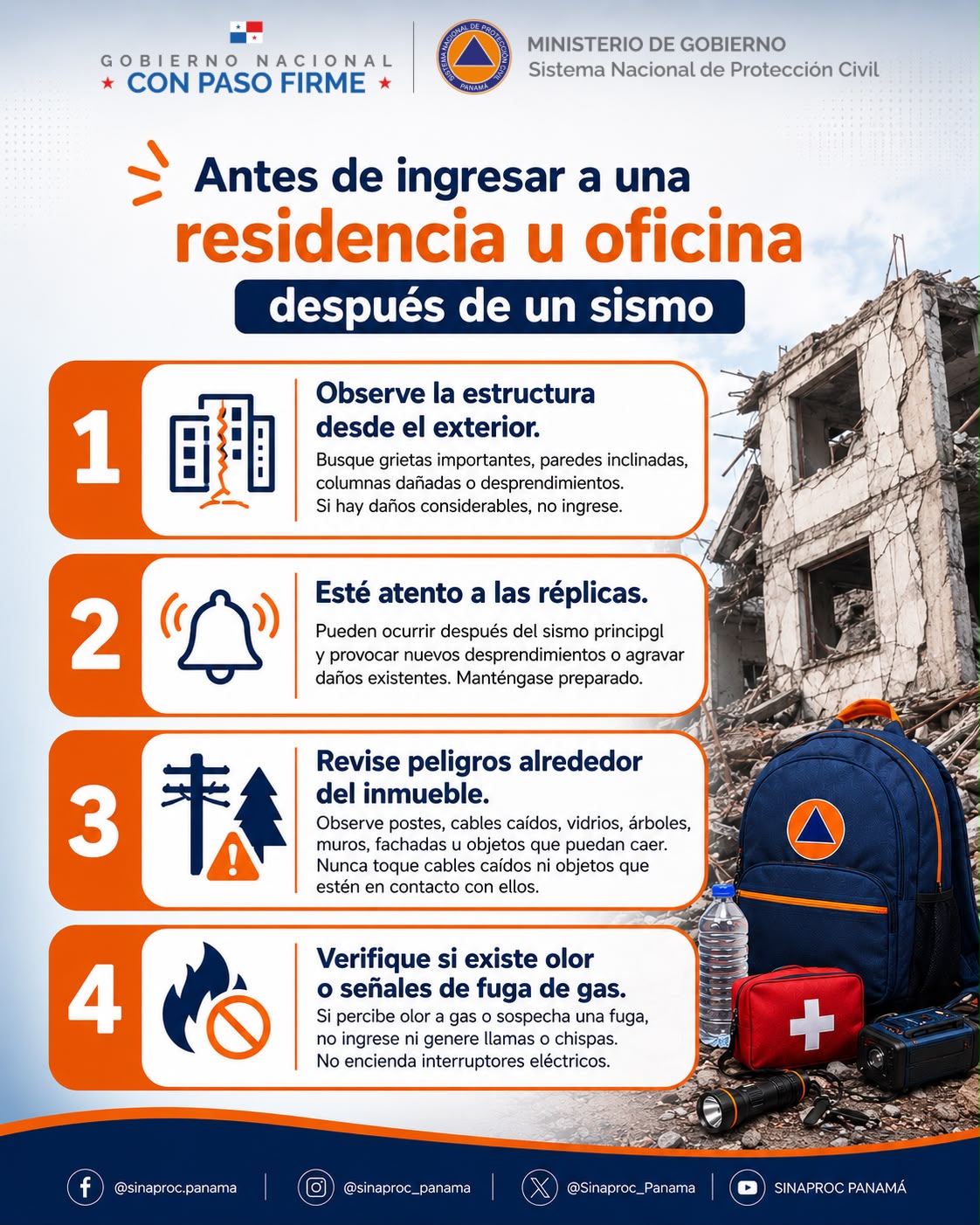
⛔ Get out, keep people away and call if you see
Damaged columns or spalled concrete, leaning walls, parts of the roof coming down or considerable damage in general. After an earthquake, SINAPROC says to look at the structure from outside and not to go in if there is considerable damage. Source: SINAPROC, August 2026 infographic
Bent or broken bars also weigh heavily: an evaluation manual counts buckling or fracture of the steel among severe damage to columns and beams. Source: CENAPRED, p. 80
Emergencies: 911 or SINAPROC 520-4426 / 520-4427 / 520-4429, WhatsApp 6998-4809 (from any phone, 24 hours a day). Source: SINAPROC, official website
If you still do not know whether it is safe to go back in, start with our guide Is it safe to enter my house after an earthquake?. If the crack is in a wall rather than a column or beam, the right guide is how to tell whether a wall crack needs a professional evaluation.
Reading map
Explore the key questions
Open a number on the drawing or a card to choose where to read next.
Illustrative diagram, without scale or diagnosis.
1Affected element
Column, tie column or beam? Identify what you have
The name matters because it changes the size, the steel inside and what the same crack means.
Read the section and its sources →2Today's action
What to do today, and what not to do
A crack whose cause is unknown is treated as active until shown otherwise.
Read the section and its sources →3Professional scope
Who evaluates and what to ask for
Diagnosing a column or beam is the job of a licensed civil engineer, preferably with structural experience.
Read the section and its sources →Column, tie column or beam? Identify what you have
The name matters because it changes the size, the steel inside and what the same crack means.
| Element | Where it is | REP-2021 minimums for a new one-story house |
|---|---|---|
| Tie column (columna de amarre) | At corners, at intersections of interior and exterior walls, and at the ends of every free-standing wall | 100 mm thick by 250 mm, with 2 No. 4 bars vertical and No. 3 stirrups every 200 mm |
| Tie beam (viga de amarre) | On top of every wall, interior and exterior | 100 mm by 250 mm high; those supporting the roof, with 2 No. 4 bars and No. 3 stirrups every 200 mm |
| Building columns and beams | Apartment buildings, multi-story houses, commercial units | Set by each project's design; chapter 7 of the REP does not cover them |
These are minimums for designing a new house under REP-2021, in force since April 2023. An older house may not meet them, and that is only known by measuring what was built: the code requires the evaluation of an existing structure to be based on what was actually built, with plans only as a preliminary reference. Source: REP-2021, 15.3.1, p. 105
⚠ A tie column is slender
Its minimum size in the REP is 100 mm thick with two bars. For reference, the Mexican manual we compare in section 05 rates as severe damage an inclined crack wider than 1 mm in its equivalents, the castillos, while in the block wall that category starts above 5 mm. Source: REP-2021, 7.3.3.2; CENAPRED, p. 80
What each crack pattern can mean
Each pattern has a known technical explanation. Use it to describe what you see accurately, not to diagnose.
Swipe the diagram sideways to see all of it.
| What you see | What it can mean | What to do | Source |
|---|---|---|---|
| A. A crack inclined at about 45 degrees across the column or beam, or two forming an X | Significant shear | Do not patch. Restrict use of that area and get an evaluation. | CENAPRED, p. 72 |
| B. Horizontal cracks in a column | Bending | Note how many, at what height and whether they reach the other face. | CENAPRED, p. 72 |
| E. Vertical cracks in a beam | Bending | Note where they are along the beam and whether floors or ceilings above are deforming. | CENAPRED, p. 72 |
| C. Straight, parallel cracks following the bars, with rust stains | Steel corrosion | Do not paint over it. Find where the water comes from and get an evaluation. | USACE, pp. 2-10 and 3-6 |
| D. Spalled concrete with bars showing | Rust, bond loss or crushing | Do not cover it with mortar. If the bars are bent, move away and call. How it is repaired: exposed rebar and spalling concrete. | CENAPRED, pp. 73 and 80 |
| Hairline crack only in the paint or plaster covering the column, with no other signs | May be the finish | Record it from a safe place. If you cannot confirm it is limited to the finish, request assessment before patching; a period without change does not confirm that. | See the wall cracks guide |
A crack separating a wall from its column, along the joint between them, is a different case: it is at the connection, not inside the column. Log it like the others and tell the engineer; the guide crack between a wall and a column covers that case. For hairline cracks in plaster and cracks in block walls, follow the matrix in the wall cracks guide.
Why width is not enough
Top search results keep repeating that a crack "wider than 2 or 3 millimeters" needs checking. We found no Panamanian source behind that rule.
All three figures come from the same Mexican manual for trained evaluators, and they show why a single number does not work: the same millimeter weighs differently depending on the element and the type of crack. That manual also counts buckling or fracture of the steel as severe damage, regardless of crack width. Source: CENAPRED, p. 80 It is not a Panamanian standard or a rule for a homeowner to declare a house safe: it is a criterion applied within a complete evaluation.
Steel corrosion: the Panama case
Not every crack in a column comes from an earthquake. In a tropical climate and near the sea, rusting steel is a cause worth ruling out.
Rust takes up about eight times the volume of the original steel. That expansion cracks the concrete and eventually spalls it, while corrosion also reduces the bar's cross-section. Rust stains appear first; then straight, parallel cracks with the same spacing as the bars. Steel too close to the surface or exposed to chlorides is what corrodes. Source: USACE, EM 1110-2-2002, pp. 2-10 and 3-6
In Panama, researchers at the Technological University exposed reinforced concrete slabs in Penonomé and Tocumen, about 20 km from the coast, and concluded that the marine-industrial environment was the most critical. Source: Sánchez and Hernández, UTP, 2021, pp. 59-64 Another UTP study, with slabs in Tocumen, Sherman (Colón) and Coclé, notes that buildings deteriorate particularly in tropical climates and that Sherman has a very high concentration of airborne chloride from waves hitting the breakwater. Source: Cedeño de Sánchez et al., UTP, 2022, pp. 10-11
That is why REP-2021 requires houses to be designed for durability, for a service life of at least 50 years, considering how aggressive the environment is, the concrete cover over the steel and the chloride content. Source: REP-2021, 7.4.1.3, p. 69 So, for a rusty column in a beach house or next to a leak, ask the engineer to also check where the moisture comes from. For moisture and leaks, see our guides on efflorescence on walls and waterproofing.
What to do today, and what not to do
- Photograph the whole column or beam and a close-up with a ruler next to the crack, always from the same spot.
- Mark the ends in pencil with the date, and check the other face if you can reach it. Source: FEMA 306, p. 31
- Note any rust stains, nearby moisture or loose concrete.
- Restrict use of that area until an engineer sees it.
- If you live in a condominium, notify the administration in writing.
- Don't fill, patch or paint it: that hides the evidence and, if the crack is still active, it reopens. Source: USACE, p. 4-7
- Don't cover rusty steel with new mortar: corrosion is treated by removing and replacing the damaged concrete; the procedure is in exposed rebar and spalling concrete. Source: USACE, p. 4-7
- Don't drill, cut or hang new loads from that column or beam: modifying sections or increasing loads counts as a change to the structure. Source: REP-2021, 15.1
- Don't hire "jacketing" without a diagnosis and a signed and sealed design. Source: REP-2021, 15.1; Ley 15 de 1959, art. 4
A crack whose cause is unknown is treated as active until shown otherwise. Source: USACE, p. 2-4 The full logging procedure is in section 07 of the wall cracks guide.
Engineer visit sheet · free
One printable page: what to note for each column or beam, the signs to tick and what to ask for in writing before approving a repair. Direct download, no data requested.
Prefer Spanish? Ficha en español.
Who evaluates and what to ask for
Diagnosing a column or beam is the job of a licensed civil engineer, preferably with structural experience.
- Signature and seal. The engineer's documents carry their signature and a seal with their name, degree and license registration number. Ask for that number. Source: Ley 15 de 1959, art. 4
- Evaluation of what was built. The REP requires working from the actual structure; field checks include measurements, extraction and testing of concrete cores when required, and a survey of the damage. Source: REP-2021, 15.3.1, p. 105
- The cause, not just the symptom. Ask for the report to say why the element cracked (earthquake, overload, corrosion or something else) and whether use should be restricted in the meantime.
- Valid before the State. Reports and drawings submitted to a public office must be prepared and presented by a licensed practitioner appropriate to their nature and JTIA rules. Source: Ley 15 de 1959, art. 21
ℹ How much does it cost?
We did not find an official or verifiable public rate for evaluating or repairing a column or beam in Panama. Ask for written proposals and compare them with the checklist in the downloadable sheet.
How it is repaired (once there is a diagnosis)
There are two families of structural work, and which one applies depends on the cause.
| Type | Goal | Examples |
|---|---|---|
| Structural repair | Restore the element's original properties | Rebuilding a section of the column or beam to the same dimensions; injecting epoxy resin into cracked concrete |
| Strengthening | Give it more strength than the original | Jacketing columns with steel plates or reinforced concrete |
| Removal and replacement (corrosion) | Remove the concrete damaged by rust and replace it | Preferred over crack sealing methods when the cause is corrosion |
- Epoxy is not for everything. Many active cracks "welded" with epoxy reopen next to the original. Source: USACE, p. 4-7
- Strengthening alters the structure. Under the REP, strengthening elements of the seismic-resisting system or modifying sections of beams and columns is a structural alteration, and chapter 15 applies to those changes. Source: REP-2021, 15.1 and 15.2, pp. 102-103
- It is inspected during the works. A rehabilitation requires systems backed by evidence, a calculation report and rigorous, documented inspection by qualified staff; if corrosion or other deterioration appears, it is reported to the design engineer. Source: REP-2021, 15.4, pp. 109-110
The municipal permit
In the district of Panama, repairing without a permit can be costly, and the minor works permit does not cover structural changes.
- The Mayor's Office says that any construction work, improvement or addition to structures needs a written permit from the Works and Construction Department (DOYC), and the applicable procedure must be confirmed before work begins. Source: Mayor's Office of Panama, FAQ
- The Visto Bueno permit is for minor works: sidewalks, fences, finishes, ceilings, floors, façades, roofs, doors and windows, among others. It excludes remodels involving structural changes, which must go through a Plano Misceláneo. Source: DOYC, Visto Bueno guide, p. 1
- Even the Visto Bueno requires an application sealed and signed by a licensed professional registered with the Technical Board of Engineering and Architecture (JTIA). Source: DOYC, Visto Bueno guide, p. 2
The DOYC guide does not name the repair of a column or beam without changes; confirm with the DOYC which procedure applies to yours before starting. In San Miguelito, Arraiján, La Chorrera, Capira or other districts, each municipality sets the procedure; this guide did not verify it.
To locate your district authority and its publications, see the official routes for Panama, San Miguelito, Arraijan, La Chorrera and Capira. Provide the proposed scope so the authority can identify the applicable procedure.
If you live in a condominium (PH)
In a building or condominium, the column is rarely yours alone. Ley 284 of 2022 sets who decides and how it is paid.
| Situation | What the law says | Article |
|---|---|---|
| The damaged column, beam or slab | Foundations, columns, beams, slabs and other structural parts are essential common elements | art. 16, item 6 |
| It is urgent and there is no time to call an assembly | The Board of Directors can approve an extraordinary expense from surpluses or reserves for an unforeseeable situation of notorious urgency | art. 6, item 20 |
| The Contingency Fund is needed | At least 1 % of all revenue and annual common expense contributions collected. The Board justifies need and amount; the Assembly decides with at least 51 % of all units. Not for routine maintenance | arts. 46 to 48 |
| Owners need to meet quickly | Extraordinary assembly for urgent needs; if it is not called within 48 hours, 20 % of owners in good standing can call it | art. 64 |
| The slab or wall is shared between two units | The owners pay in equal parts; if one caused the damage, they pay within 30 days | art. 24 |
| A unit caused the damage | The occupant is liable; a licensed expert determines amount and origin | arts. 29 and 56, item 15 |
| Who does the repair | Owners must use only qualified personnel for repairs and modifications | art. 56, item 9 |
If the Board still has the building's approved plans, ask for them: the developer must hand them over. Source: Ley 284 de 2022, art. 54 For interior walls and what you can touch inside your apartment, see the guide can I remove a wall in my apartment?.
Common mistakes
- Patching and painting to "see if it comes back". The evidence is lost, and an active crack reappears. Source: USACE, p. 4-7
- Treating rust as a stain. Behind a rust stain there may be a bar losing cross-section. Source: USACE, p. 3-6
- Using a millimeter rule from the internet. There is no Panamanian rule of that kind (see section 05).
- Hiring the strengthening before the diagnosis. Jacketing is a structural alteration that has to be designed. Source: REP-2021, 15.1; CENAPRED, p. 61
- Repairing without a permit because "it is just patching". Source: Mayor's Office of Panama
- In a condominium, fixing it on your own. It is an essential common element and goes through the administration. Source: Ley 284, art. 16
Three examples to help you decide
Illustrative cases, not real client cases.
1. Beach house, stained column. At the corner of the terrace, a column shows rust-colored stains and two straight, parallel cracks at the height of the bars.
Decision: pattern C. Do not paint or patch; find where the water gets in and get the corrosion evaluated.
2. Apartment, inclined crack in a column in the common hallway. After a tremor, a diagonal crack appears across the column.
Decision: pattern A in an essential common element. Notify the administration in writing; the Board can act on notorious urgency and a licensed engineer defines the repair.
3. Hairline crack in the plaster of a living room column. A thin line, only in the paint, with no rust or spalling; no change in 30 days.
Decision: it may affect only the finish, but the 30 days in this example do not establish stability or cause. If the affected layer is unknown, request assessment before patching; report any change or rust.
Frequently asked questions
Are cracks in columns dangerous?
What does a horizontal crack in a column mean?
What does a vertical crack in a column mean?
What does a diagonal crack in a column or beam mean?
What does a crack in a beam mean?
Is there a safe crack width in a column?
How is a crack in a concrete column repaired?
What is column jacketing?
My column has rust and the concrete is falling off. What do I do?
Do I need a permit to repair a column or beam?
I live in a condominium (PH). Who repairs a damaged column?
Can a mason repair the column?
Sources
Consulted on October 10, 2026. Scanned documents were read with OCR and checked against the original image. Panamanian titles are kept in Spanish.
Notice. This guide is general educational information. It is not a technical report, it does not declare any home safe and it does not replace an inspection by a licensed professional or the instructions of SINAPROC or another competent authority. United States and Mexican sources explain technical criteria; they are not Panamanian standards. The municipal procedures described apply to the district of Panama. Content verified in October 2026. Prepared by Gallardía (gallardia.lat).
Organizing the repair
Once a licensed engineer has defined the repair, Gallardía can visit the home and quote the remodeling, painting and finishing work that follows. The diagnosis and the structural design are the job of a licensed engineer. See how to commission the inspection and report before requesting a repair quote.
Keep reading on Gallardía
This guide is part of the series on home damage: safety first, then diagnosis, then repair.