Cracked, wet or fallen drywall ceiling: what to do and when to replace it
A straight crack in the ceiling, a water stain that keeps growing, a panel that bulges or a piece already on the floor cannot be fixed with compound and paint if nobody knows the cause. This guide explains what kind of ceiling you have, which signs call for action today, when wet gypsum board can be dried and when it must be replaced, and how to repair it so the crack or the stain does not come back.
- SafetyIs it safe to go in?
- DiagnosisWhat does the crack mean?
- Repair · You are hereDrywall ceiling
- DecisionRepair or rebuild?
Short answer
If the ceiling drips, bulges or hangs, keep people away, do not touch wet light fixtures and find where the water comes from. If it only has a dry crack, look at where it is: on a joint, at the corner with the wall or across the panel, because each points to a different cause. Wet gypsum board is replaced unless several conditions are all met, and when in doubt, it is replaced.
ℹ The essentials in 60 seconds
Water decides. The Gypsum Association recommends replacing gypsum board that got wet, unless the source has been eliminated, the water was clean, the board can be dried completely before mold appears (typically within 24 to 48 hours) and the board and its framing are sound. Source: Gypsum Association, GA-231-2025, p. 1
Swollen or with open seams, it goes. The EPA says wet wallboard may be dried in place only if there is no obvious swelling and the seams are intact. Source: EPA, table 1
Do not paint over mold. Paint applied over moldy surfaces is likely to peel; clean and dry first. Source: EPA, brief guide
A crack has a cause. In gypsum board, joint cracks usually come from structural movement, expansion from humidity and temperature, or joint compound that dried too fast. Source: CGC, p. 344
First: is there danger today?
⛔ Do not stand underneath, and call if you see
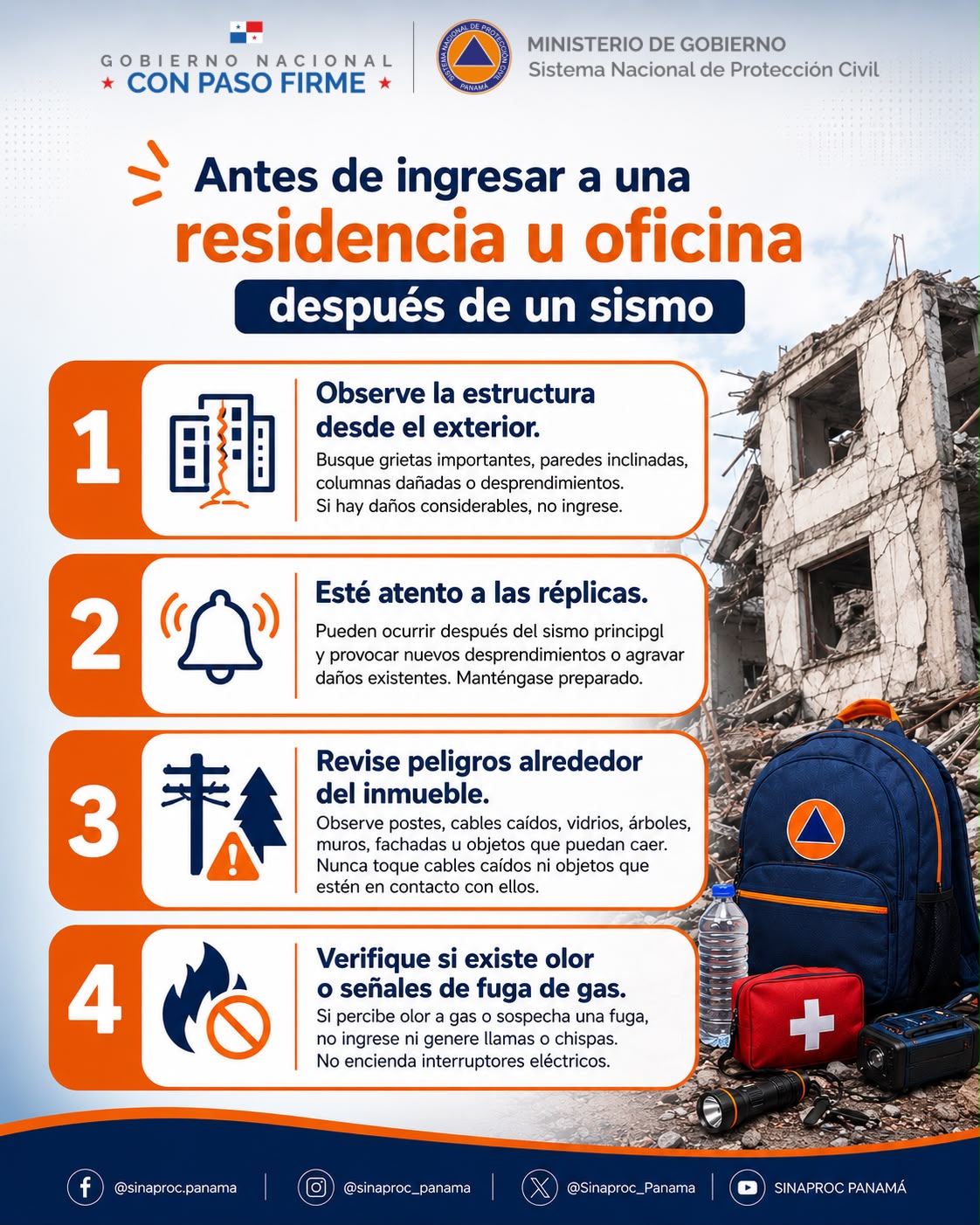
Parts of the roof or ceiling hanging after an earthquake, together with cracks in walls or columns. SINAPROC asks people to look at the structure from outside and not to go in if there is considerable damage. Source: SINAPROC, August 2026 infographic, step 1
Emergencies: 911 or SINAPROC 520-4426 / 520-4427 / 520-4429, WhatsApp 6998-4809 (from any phone, 24 hours a day). Source: SINAPROC, Sismos
- A ceiling that bulges or drips can give way. Water softens the gypsum core and loosens its paper. Source: CGC, p. 345 FEMA warns that ceilings attached to the structure are particularly vulnerable when they have deteriorated from roof or plumbing leaks. Source: FEMA E-74, p. 6-109 Keep the area clear without approaching or standing underneath to move objects.
- Water and electricity. Moisture in cables or outlets can cause short circuits and shocks, and electrical installations are checked by a licensed professional. Source: Fire Department, October 29, 2025 Do not touch a wet fixture or outlet; after an earthquake, SINAPROC asks people to cut off the electricity. Source: SINAPROC, Sismos
- Suspended ceilings. In ceilings with panels on a hanging grid, lights and diffusers without their own safety wires can fall. Source: FEMA E-74, p. 6-95
If you are unsure about going in after an earthquake, start with is it safe to go back into my house after an earthquake?
Reading map
Explore the key questions
Open a number on the drawing or a card to choose where to read next.
Illustrative diagram, without scale or diagnosis.
1Fall area
First: is there danger today?
If you are unsure about going in after an earthquake, start with is it safe to go back into my house after an earthquake?
Read the section and its sources →2Water and board
If it got wet: dry it or replace it?
The Gypsum Association and the EPA agree: wet gypsum board is replaced, with clear exceptions.
Read the section and its sources →3Repair scope
How to repair it so it does not come back
To budget a new ceiling, see how much a drywall or PVC ceiling costs .
Read the section and its sources →What kind of ceiling you have
The answer depends on how it is hung.
- Furring hung from the roof structure; FEMA calls for positive connections protected from water (FEMA E-74, p. 6-114).
- Gypsum board screwed in place (FEMA E-74, p. 6-108).
- Joint with tape and compound: where straight cracks usually appear (CGC, p. 344).
- Wires hanging the grid (FEMA E-74, p. 6-94).
- Grid of T-sections, usually 2 × 2 or 2 × 4 feet, with lightweight panels on top (FEMA E-74, p. 6-94).
- Perimeter next to the wall: where instability usually starts (FEMA E-74, p. 6-95).
- Light fixture with its own safety wire (blue): without it, it can fall (FEMA E-74, p. 6-95).
Panels screwed to framing or to the structure, with the joints covered with tape and compound so it looks like one continuous surface. FEMA notes that these finishes can be a falling hazard if they are not anchored with strong positive attachments. Source: FEMA E-74, p. 6-108
A grid of inverted T-shaped metal sections, usually 2 × 2 or 2 × 4 feet, hung with wires, with lightweight panels resting on top. Source: FEMA E-74, p. 6-94 Panels and grid hold each other up: if one part fails, the whole ceiling can become unstable. Source: FEMA E-74, p. 6-95
In Panama, the structural code describes the typical single-family home with a ceiling suspended from the roof structure under a corrugated metal roof. Source: REP-2021, 7.2.2, p. 52 That is why a roof leak often shows up first as a stain on the ceiling; the guide on roof leaks explains how to find where it gets in.
What each sign means
Use this to set priorities, not as a diagnosis.
Urgent or high priority
- Ceiling hanging, sagging or bulging with water
- Parts fallen after an earthquake, with cracks in walls or columns
- Wet light fixture or outlet
- Water stain that grows or drips
Medium priority
- Sagging ceiling with no visible water
- Stained suspended ceiling panel
- Straight crack on a joint or at the wall corner
Low priority, to confirm
- Screw or nail heads showing
Summary of the table below. Whoever inspects confirms the cause. Sources: SINAPROC; CGC; FEMA E-74; Bomberos; GA-231-2025; EPA.
| What you see | Priority | What to do | Source |
|---|---|---|---|
| Ceiling hanging, sagging or bulging with water | Urgent | Nobody underneath; shut off the water if you can do it safely and call a professional. | CGC, p. 345; FEMA E-74, p. 6-109 |
| Parts fallen or hanging after an earthquake, with cracks in walls or columns | Urgent | Do not go in if there is considerable damage; call. | SINAPROC, step 1 |
| Wet light fixture or outlet | High | Do not touch it; have a licensed electrician check it. | Fire Department, 2025 |
| Water stain that grows or drips | High | Find the source: roof, gutters, piping or the floor above. | Fire Department, 2025; Gypsum Association |
| Sagging ceiling, no visible water | Medium | Check the framing and anything resting on it; compound does not fix it. | CGC, pp. 345 and 349 |
| Stained or wet suspended ceiling panel | Medium | Replace the panel and fix the water source. | EPA, table 1 |
| Straight crack over a joint or at the corner with the wall | Medium | Record the date and length; if it returns after repair, the cause is still active. | CGC, pp. 344 and 345 |
| Screw or nail heads showing on the surface | Low | A finish repair; check that the panel is firm. | CGC, p. 352 |
Free sheet to record it
Write down the date, place, crack length or stain size and a photo at each check; it shows whether it is growing and helps when notifying the condo administration. Direct download, no data requested.
Why the ceiling cracks
Where the crack is gives the best clue.
It appears right over the long edge or the butt end of the panels, or next to the tape. It is usually due to structural movement, expansion and contraction from humidity and temperature, or compound that dried too fast. Source: CGC, p. 344
It shows where wall and ceiling meet. It can come from structural movement, poor compound application in the corner or too many coats of paint. Source: CGC, p. 345 After an earthquake, FEMA describes cracking at the edges where ceiling and walls meet, and X-cracking. Source: FEMA E-74, p. 6-109
Usually diagonal, starting from a corner, from an intersection with the structure or from weak points such as light fixtures. Source: CGC, p. 344
The ceiling bows, especially in high humidity, because of insufficient support, panels too thin for the framing spacing, or insulation resting directly on the panels. Source: CGC, p. 345
About crack width. We found no source that allows choosing a repair for a crack in gypsum board by its millimeters alone. What matters is where it is, whether it reopens, and whether it comes with water, loose panels or cracks in block or concrete walls. For those, go to wall cracks: when to get an evaluation.
If it got wet: dry it or replace it?
The Gypsum Association and the EPA agree: wet gypsum board is replaced, with clear exceptions.
- Was it contaminated water, floodwater or sewage?Yes: replaceKeeping a board requires uncontaminated water, according to the Gypsum Association.
- Is the panel swollen or have its seams opened?Yes: replaceRemove and replace, according to the EPA.
- Is the water source still active?Yes: stop it firstNo panel goes back while water keeps coming in.
- Is there mold, paper delamination, a soft core, rusted fasteners or damage affecting the system?Yes: replaceIt does not meet the conditions to keep it.
- Is there any doubt left?Yes: replaceThe Gypsum Association's own wording.
- Does it meet every condition and can it dry thoroughly before mold begins?Yes: it can be dried in placeAssessment and final inspection decide; 24 to 48 hours is guidance, not a guarantee.
- It can be kept only if all of these are met: the water source was found and eliminated; the water was not contaminated; the board can be dried completely before mold grows, typically within 24 to 48 hours; and the board is sound, without rusted fasteners, delaminated paper, a soft or powdery core, or damage diminishing the system properties. Source: Gypsum Association, GA-231-2025, p. 1
- Swelling or open seams: remove and replace. Source: EPA, table 1
- Floodwater or sewage: always replace. Source: Gypsum Association, GA-231-2025, p. 1
- Wet suspended ceiling panels: discard and replace. Source: EPA, table 1
- When in doubt, replace. This is the GA-231-2025 recommendation. After thorough drying, the board needs a final inspection before redecorating. Source: Gypsum Association, GA-231-2025, p. 1
Mold. Even if materials are dried within 48 hours, mold may have grown. Source: EPA, table 1 If the moldy area is small, under about 10 square feet (around 0.9 m²), the EPA considers that in most cases homeowners can clean it following its guidelines; if it is larger or there was a lot of water damage, it refers to its guide for professionals. Porous materials, such as ceiling panels, may have to be thrown away. Source: EPA, brief guide
Time alone does not decide. The 24 to 48 hours guide a rapid response; they do not prove the board is mold-free or require replacement at an exact deadline. Assess water, condition and drying. A fire-resistance or sound-rated ceiling must be repaired consistently with its original assembly design. Source: GA-231-2025, p. 1; EPA, table 1 and notes
How to repair it so it does not come back
- Stop the waterroof, gutters, piping or the floor above
- Decide which panels stayusing the criteria in section 06
- Check what holds itframing and fasteners firm and rust-free
- Replace and treat jointsnew panels, tape and compound
- Paintonly when dry and mold-free
- Stop the water. Check the roof, gutters and drains. Source: Fire Department, October 1, 2025 If it comes from a pipe or the floor above, fix that first.
- Decide which panels stay using the criteria in section 06. Sources: Gypsum Association, GA-231-2025, p. 1; EPA, table 1
- Check what holds the panel. FEMA calls for positive connections from the board to the furring and from the furring to the structure, protected from water and corrosion. Source: FEMA E-74, p. 6-114
- Replace damaged panels and treat their joints with tape and compound.
- Paint once it is dry and free of mold. Source: EPA, brief guide
- A crack that returns: if it comes from structural movement or from humidity and temperature, the CGC handbook says to correct those conditions first and provide relief, then retape; for large ceilings it calls for control joints. Source: CGC, p. 349
- Sagging ceiling: remove the sagged panel or install new furring and another layer. Leveling with compound does not fix a framing, weight or recurring moisture problem. Source: CGC, p. 349
- Suspended ceiling: replace wet panels and check the perimeter of the grid, where instability usually starts. Sources: EPA, table 1; FEMA E-74, p. 6-95
- Screw or nail heads showing: the CGC handbook attributes them to poor application or wood shrinkage; a loose fastener is removed and replaced with a properly driven screw. Source: CGC, p. 352
To budget a new ceiling, see how much a drywall or PVC ceiling costs.
After an earthquake
- The ceiling is not the structure, but it can fall. REP-2021 requires important nonstructural elements, such as large architectural elements, electrical components and ducts, to be checked against chapter 13 of ASCE 7-05. Source: REP-2021, 1.6.5, p. 5
- Suspended ceilings: failure often starts at the perimeter, where the grid rests on the wall, and differential movement between the ceiling and columns, walls or sprinklers damages it locally. Source: FEMA E-74, p. 6-95
- Attached ceilings: cracks can appear at the edges with the walls or in an X pattern. Source: FEMA E-74, p. 6-109
- Look beyond the ceiling. If there are also cracks in walls, columns or beams, the ceiling is the last thing to repair: start with wall cracks or crack in a column or beam.
If you live in a condo (PH), and the permit
- Water from another unit. Each owner must repair and pay for damage from their unit that affects another, under article 29, which provides for a licensed expert to determine origin and amount. Source: Ley 284 de 2022, arts. 29 and 56, num. 15
- The administrator orders urgent repairs in common areas and asks owners for urgent repairs of damage affecting another unit. Notify them in writing, with photos and the date. Source: Ley 284, art. 93, num. 12 and 13
- Permit in the district of Panama. The Visto Bueno permit for minor works includes ceilings in homes; electrical, plumbing or structural changes are processed as a Plano Misceláneo. Source: DOYC, Visto Bueno guide, 2026, p. 1
In other districts each municipality sets the procedure; this guide did not verify it.
To locate your district authority and its publications, see the official routes for Panama, San Miguelito, Arraijan, La Chorrera and Capira. Provide the proposed scope so the authority can identify the applicable procedure.
Common mistakes
- Painting the stain without stopping the water. It comes back, and if there is mold the paint peels. Source: EPA, brief guide
- Leaving a swollen panel to dry «to see if it recovers». Source: EPA, table 1
- Leveling a sagging ceiling with compound. Source: CGC, p. 349
- Choosing the repair by the crack's millimeters without looking at where it is or whether it returns. Source: CGC, pp. 344 and 345
- Reusing wet suspended ceiling panels. Source: EPA, table 1
Three examples to decide
Illustrative cases, not real client cases.
1. The hallway crack. A thin straight line over a ceiling joint, dry and without stains. It was patched a year ago and came back.
Decision: row «crack over a joint». Find the cause (movement, indoor humidity, compound) before retaping, and record whether it grows.
2. The bedroom under the neighbor's bathroom. A yellow stain that grew in a week, and the panel is starting to bulge.
Decision: rows «bulging with water» and «stain that grows». Nobody underneath, written notice to the administration, fix the leak upstairs and replace the swollen panel.
3. After the earthquake, three suspended ceiling panels in the living room are on the floor, with no cracks in walls or columns.
Decision: check the perimeter of the grid and that the light fixtures have their own support before putting the panels back.
Frequently asked questions
How are cracks in a drywall ceiling repaired?
What size of crack in drywall is serious?
Can a damp ceiling be painted?
Can wet drywall be dried or must it be replaced?
What do I do if the ceiling fell?
Why is the ceiling sagging?
Why does the ceiling crack at the corner with the wall?
Can wet suspended ceiling panels be reused?
Why do screw or nail heads show on drywall?
Do I need a permit to replace the ceiling?
I live in a condo (PH) and the water comes from the apartment above: who pays?
Sources
Consulted on October 10, 2026. Scanned documents read with OCR and checked against the original image.
Notice. This guide is general educational information. It is not a technical report, it does not declare any ceiling or home safe and it does not replace an inspection by a licensed professional or SINAPROC's instructions. The United States and Canadian sources describe good practice and products from those countries; they are not Panamanian standards. The procedures described apply to the district of Panama. Content verified in October 2026. Prepared by Gallardía (gallardia.lat).
Organizing the ceiling repair
Once the water source has been fixed, or the crack is only in the finish, Gallardía can quote replacing panels, joint treatment, a new ceiling and painting. If there is structural damage, the evaluation is the job of a licensed engineer.
Keep reading on Gallardía
This guide is part of the series on home damage: safety first, then diagnosis and then repair.